Monday, June 3, 2013

Mercurial May

What a strange month May was this year! It seems that every time I had a day off work to go out nature-watching, it was either rainy, cold, windy, or dark and gloomy; none are good conditions for bird photography, and of course butterflies and dragonflies were scarce, if flying at all. Nonetheless, I was able to  visit a few places and take a few photos to share with you.


To start out the month, my aunt from California flew in to Richmond for a couple of Roads Scholars trips (previously named Elderhostel), and I spent the weekend and my birthday with her in Richmond. On Saturday we went to Maymont Park (photo above), but spring had not yet arrived there; it was cold and cloudy. It's a gorgeous park, though, and I intend to go there sometime in the summer; it has lots of possibilities for butterflies and dragonflies.

On Sunday we went on a pontoon boat Bald Eagle tour up the James River with Captain Mike, owner of "Discover the James" (http://www.discoverthejames.com). I highly recommend his trips; his pontoon boat seats six participants and he drives it about seven miles along the James pointing out the wildlife along the way. The focus of our trip was Bald Eagles, and they did not disappoint; we saw about 7 or 8 of them. Mike knows them all and their territories, as he has studied them for years, and knows where to find them. Unfortunately for me, it was another dark and dreary day, and the eagle photos I took are a bit dark and blurred -- but I'll share one anyway. The first photo below is of one of the Bald Eagles in flight clutching a fish, and the second is a Great Blue Heron that has just grabbed a fish that Captain Mike threw its way.


On the home front in Chesapeake, breeding season is in full swing. I have a bird house in my front yard that was investigated early in the month by Chickadees and even Eastern Bluebirds, but in the end a pair of House Wrens won the battle for it, and have built their nest inside; I should hear the babies soon.

Eastern Bluebird male investigating the bird house


One of the House Wrens that won the battle for the bird house.

An interesting fact about House Wrens: the males arrive on their breeding territories earlier than the females, and spend their time building multiple nests to impress the females. When the female arrives, she will hop from nest to nest to nest, and finally pick the one that strikes her fancy. Or desert to the neighboring male if she likes his nests better.

Last fall I posted photos in this blog of some impressive moth caterpillars that friends and neighbors brought to me. I put the caterpillars in my screen cages, and fed them until they went into their cocoon or pupae stages. They overwintered in that stage on my front porch, and two weeks ago one of them, the Polyphemus Moth, emerged! Below is the photo I took last fall of the caterpillar, followed by the moth:


I didn't even realize that the moth had emerged until I noticed two other Polyphemus Moths that were perched on my house near the cages. I then realized that "my" moth had emerged, and she was a female! Females send out their scent, or pheromones, and males can detect that scent from several miles away; the two moths on my house were males that came looking for my female. Here's a picture of one of the males; one of the ways to tell the male and females apart is to look at their antenna. The male's are much "fatter" than the female's (You can click on my photos to get an enlarged version for closer viewing):


By the next day I had five males, so I put them all in the cage with the female, hoping they would breed, which they did:


I should have kept the female in the cage with the leaves of her host plant (Oak), so she could lay her eggs and I could raise more caterpillars; this is what most other butterfly and moth enthusiasts would have done. But the adult Polyphemus Moth, like most of the other large Silk Moth species, lives for only seven days, and I just didn't want her to die in my cage. So I left the cage door open one night and all the moths left to complete their life cycles in the wild.

This is also the time of year that Luna Moths, another of the Silk Moths, emerge from their overwintering cocoons. Below is one that we found on the library's outside brick wall. Like the Polyphemus Moth, Lunas emerge, breed, lay eggs, and die within a 7-day span. They do not eat or drink in the adult stage; their sole purpose is to reproduce.


On a warm day in mid-May, I took a short walk along the Dismal Swamp Canal Trail in Chesapeake. If you haven't been there, you should go check it out. An 8.5-mile multi-use trail runs along the Dismal Swamp Canal, paralleling the old Route 17 to the North Carolina border. It is used by nature lovers, runners, bicyclists, and all manner of outdoor enthusiasts. (Check out the website at  www.cityofchesapeake.net/DSCT). I generally prefer to bird on the less populated west side of the Dismal Swamp, accessed in several places from Suffolk, but the Canal Trail is a nice, quick, easy place to access some of the Swamp's unique habitat if I don't have a lot of time to travel over to Suffolk.

Since the weather was warm, a few butterflies were active, and even though none were unusual species, I enjoyed photographing some "old friends." Here are a few favorites:

 Red-spotted Purple Butterfly
A lot of our swallowtail species also have black-with-blue coloration, but note that the 
Red-spotted Purple does not have the "tails" that the Swallowtails do.

 Zebra Swallowtail

 Tiger Swallowtails mineraling 

Spicebush Swallowtail

Blue-Gray Gnatcatcher


I threw in the photo of the Gnatcatcher because I've been trying, unsuccessfully, to get a decent photo of one, and I finally did. These tiny little birds are almost everywhere in the spring and summer months, and you've undoubtedly heard them even if you didn't know it; they have a soft wheezy, nasally, rambling song. These little guys are very active, like Kinglets, and are usually flitting about high up in a tree. They are also very curious; if you make "pishing" sounds, they will usually come in closer to investigate you, which is what the one in my photo did.

So, here comes summer now, and I hope that the excessive rains we had in May finally cease! If they do, I'll be out looking for birds and insects to photograph at Mackay Island, Piney Grove, Back Bay, Maymont Park, and hopefully some places in the Piedmont and in the Blue Ridge; the more different kinds of habitat you visit, the more possible species there are to find. I'll let you know what I saw next time, and if you want to share your own sitings with me, please feel free to comment. Or better yet, bring your photos to my next "Nature Photo Night" at the Chesapeake Central Library, which will be on Monday, July 29 at 6:00 p.m. Call me at 410-7147 if you would like more information about this -- ask for Karen.

Saturday, May 11, 2013

A Mid-April Colorado Birding Trip


On April 13 I flew to Denver to join up with a group of nine other Virginia birders for a one-week birding extravaganza covering the whole state of Colorado. Our leader carefully planned our daily itineraries which centered around seeing as many bird species as possible, with a big emphasis on seeing rare birds and western “specialties” that we do not see on the Atlantic coast. Most of us had targeted several “life birds,” which are species that one has never seen before. Life birds are the Holy Grail of birdwatching, and obviously the longer you have birded and the more species you have seen, the more difficult it is to find and see a new life bird. That’s the advantage of joining up with a group led by an experienced leader who does all the work, figuring out where and when to go to have the best chance of seeing the rare or hard-to-find species.

We certainly experienced ups and downs during the week; the “ups” included all the great birds and scenery that we did see, the fellowship with the other birders and making new friends, and for me, just being back “out west” where I was raised and where my heart is. The “down” was a big one, though; the weather had a huge impact on the trip and made it impossible to go to many of the places we had planned to bird.


We started in the far southeastern corner of Colorado in prairie and grassland habitat, where temperatures were cool but at least there was no snow, and roads were passable. Our first early morning stop at a Lesser Prairie Chicken lek produced one lone bird that was quite far away from our blind and did not remain long, but it was the first life bird of the trip for most of us. Other birds typical of this habitat included the bird pictured above, the Long-billed Curlew, and below, the Greater Roadrunner.


We drove then to the western part of the state where we started to see the first signs of snow in the higher elevations; it was just beautiful and all the roads were still passable. We visited Gunnison National Park and Colorado National Monument, which are both near Grand Junction, close to the Utah border. Both places were stunning; here is a photo of  the Black Canyon at Gunnison N.P.:


We hoped to see a Dusky Grouse at Gunnison, and we drove slowly along the roads in the morning hoping to find one along the shoulder of the road. All grouse species are notoriously difficult to find away from their leks, like trying to find a needle in a haystack, but our leader was successful in finding a Dusky for us – here it is:


Colorado National Monument is a gem of a place that few people know about; it’s like a mini Grand Canyon with gorgeous red rock formations and canyons. The weather had turned darker and drizzly by the time we got there, but we walked around and found some of the common bird species like Spotted Towhee, Juniper Titmouse and Say’s Phoebe. Here are a couple of snapshots of the views there:


Our next destinations were in northern Colorado, where we ran into some major weather. Everything was blanketed in snow, so our best chance of finding any birds for the next few days was to visit bird feeders  where we had great success. Here are some of my favorites:


I've only seen Common Redpolls (above and below) once in all my years of birding, so seeing them in good numbers at the feeders was a real treat. Redpolls are northern finches that move south into the lower 48 in the winter, but they are usually restricted to the northern tier of states and are somewhat unpredictable in their occurrence. They usually wander around in groups eating from the seed heads of thistles and other seed-bearing plants, but since all of those plants were covered by the snow, they took advantage of the niger seed that people put in their feeders. Just look at this group!--


Another of my favorites is a bird of high elevations and northern states, the Pine Grosbeak. We do not see them in Virginia; they occur far to the north of us. Pine Grosbeaks are actually a large species of finch; here is a beautiful male:


Below is a Mountain Chickadee, a bird of the western mountains. It is a "cousin" to southeast Virginia's Carolina Chickadee. My roommate liked this photo and thought we should caption it "Take that, Bluebird!"


In the eastern states we get Red-winged Blackbirds, but not Yellow-headed Blackbirds. Here is a photo of one of each (males), looking annoyed with with weather -- (or maybe they're annoyed with me?)


And one last feeder bird that I must share with you, because it was a life bird for me. The Brown-capped Rosy Finch occurs almost exclusively in Colorado, and loves high altitudes, snow and freezing temperatures. We certainly had all of the above that week, and we saw hundreds of these little guys at various feeders.


This has been just a thumbnail sketch of our trip, but I hope it gives you a little taste of Colorado birding and nature. I would love to go there again in less extreme weather -- as I indicated, there were many places we could not go, and birds we could not see. We were there during the worst snowstorm Colorado has had in three years, and no one could have predicted that. We actually did drive up to Loveland Pass hoping we could search for Ptarmigan, but it was minus 12 degrees there plus 60 mph winds with stronger gusts. It was almost a complete whiteout; in fact, five snowboarders tragically died there in an avalanche the next day. 

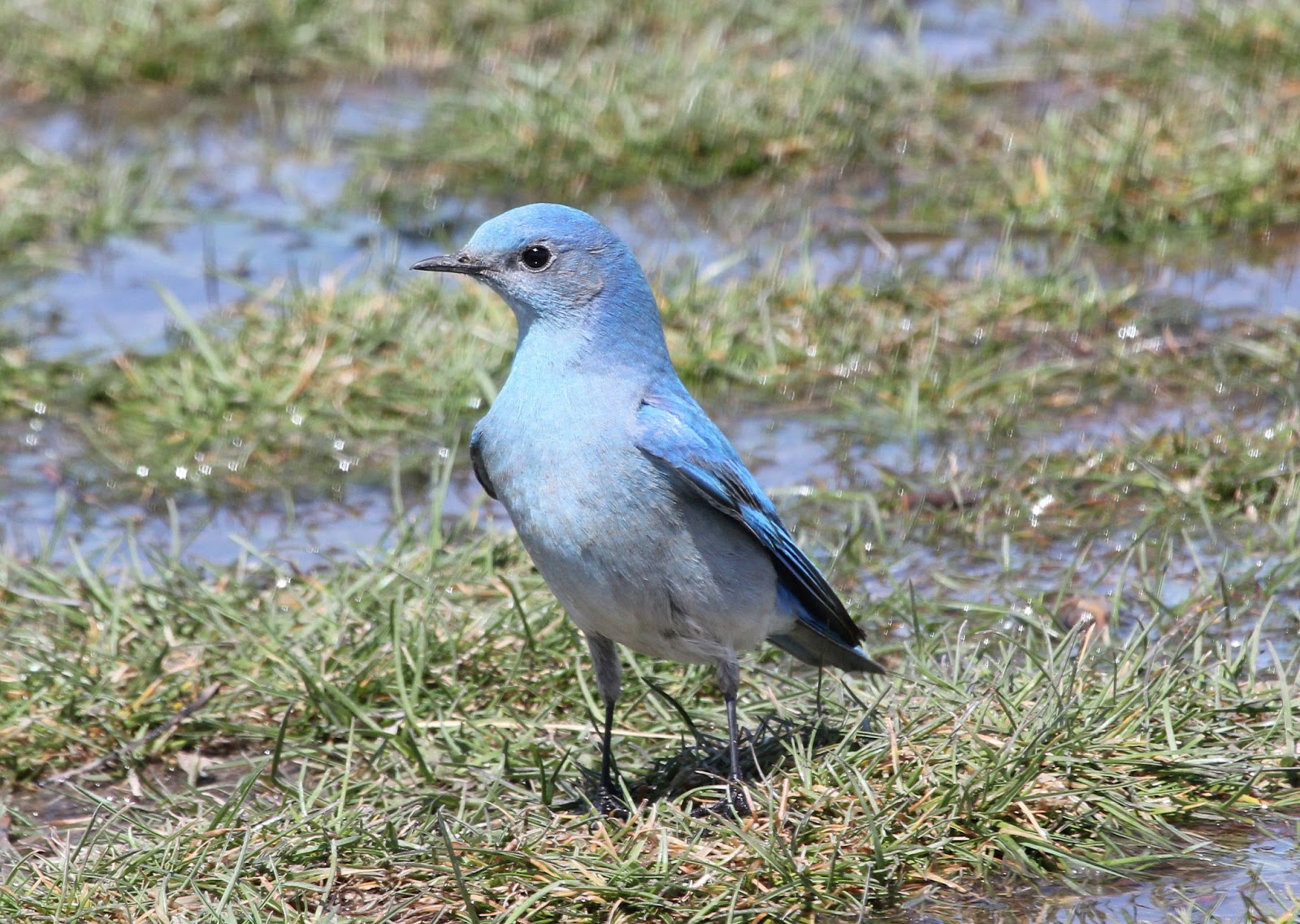
But focusing on the positive side, we saw a lot of gorgeous places and beautiful birds, and I will end with a photo of one of the most beautiful, a male Mountain Bluebird. What more is there to say?


Wednesday, March 27, 2013

Winter Birds At My Chesapeake Yard

  
No question, I see a lot more birds at my Chesapeake bird feeders in the winter than I do in the other seasons. In the warm seasons, many of the birds we see are insect-eaters and do not use bird feeders that offer seeds. And the seed-eaters can find all the food they want naturally, and are less dependent on our feeders. In the winter, food is harder to find; the insect-eaters have migrated south to warmer climates that still have insects, and the seed-eaters rely more on the easy pickin's at the local bird feeder. Winter can be the most interesting time to "feeder watch."

I had an interesting winter in my own yard this year, and I hosted some species that don't come to my yard every year. Winter birds are far less predictable than breeding birds which remain pretty much the same year-to-year. Weather patterns and food sources to the north of us affect bird movements greatly in the fall and winter, and many of the birds we see during those seasons are migrants that do not necessarily return to the same locations each year like the summer breeding birds do. Each day can bring something new and unexpected.

My first real surprise of the winter was the female Painted Bunting that visited my yard for a week or so (below). The male Painted Bunting is well known for its bright and showy colors; bright blue, red, green and yellow; the female's colors are subtle shades of green. Painted Buntings are very uncommon in Virginia, but a few seem to stray here from the southern states each year. I have seen three or four in my yard over the years, including one gorgeous male.

 
       (Here is the male bird for comparison, courtesy of  floridabirdingtrail.com)


This winter was an "irruption" year for many northern species of songbird. When cone crops and other food sources are poor in the northern states, birds that usually winter in those regions move south in search of food. An "irruption" year is one in which large numbers of these birds occur in more southern states; a few of these birds might be seen most years, but in irruption years they are conspicuous and can be quite common. The three birds below were much more common this year than in non-irruption years:


Pine Siskins are little finches about the same size as American Goldfinches, a species that they often associate with in "feeding flocks." Pine Siskins are a streaky little brown bird with variable amounts of yellow coloring in the wings. I've had anywhere from two to two dozen at my feeders all winter.


Red-breasted Nuthatches move through eastern Virginia each fall in varying numbers; the Eastern Shore is a reliable place to find a few. They do not usually stay here or visit our bird feeders, but during irruption years like this one they have been common. They are daily visitors to my feeders.


If you keep a feeder, or even if you are just a casual bird watcher, you are familiar with our resident House Finches; the males have red markings, and the females and juveniles are plain birds with blurry brown streaking. The bird in the photos above is similar to the female House Finch, but is its "cousin," a female Purple Finch, which is a separate species (note the distinct whitish stripes above and below the bird's eye; this is a reliable field mark for distinguishing the two female finches). Purple Finches do not breed in southeast Virginia, but a few do pass through during the southbound fall migration (mostly to the west of us), and some visit bird feeders. This is only the second Purple Finch I've ever seen at my feeder.


Remember this guy? Last year I wrote in this blog about the six Baltimore Orioles that spent the winter in my yard. I had kept a hummingbird feeder filled with sugar water outside during the late fall, hoping to attract a rare winter hummingbird, but instead I noticed one day that a Baltimore Oriole was drinking from the feeder. I knew that Baltimore Orioles love to eat grape jelly, so I immediately went out and bought some jelly and a feeder to put it in. Within a few weeks, I had a total of six orioles, and they spent the entire winter with me, which is very uncommon here. They must have remembered my yard and my grape jelly, because this winter  they returned; in fact they added a member to their group. All seven Orioles are still with me as of today.


All sparrows look alike to most people -- "little brown jobs," as they're called. But this one, a Fox Sparrow (above),  is special to me. Although this species does winter in our region, it is usually not seen in suburban yards; they prefer woods and unpopulated places. But this one spent two months in my yard this winter.


The bird above is also a species of sparrow, although it does not look like most sparrows at all. It is a member of the Towhee family, and this species is an Eastern Towhee. Eastern Towhees are quite common in our area, but for some reason they do not often frequent my yard even when there is free food. This year was the exception, as at least two visit me daily.


 Pine Warblers (above) are a relatively plain member of the Warbler family of birds, but in the winter they bring a much appreciated splash of color to a dreary day. They frequently come to my yard for the suet and nuts that I put out. Pine Warblers are year-round residents in southeast Virginia, and one of only two warblers that commonly winter here; the winter-plumage Yellow-rumped Warbler, below, is the other.


If you have busy bird feeders as I do, you will eventually attract one or several of the Accipiters, known commonly as "bird hawks." Accipiters do prey on small birds, and they are often much maligned for this, but they need to eat too and it's all part of the natural cycle and survival of the fittest. There are two species of Accipiter that you are likely to see in this area, the Sharp-shinned Hawk and the Cooper's Hawk. They are extremely similar in appearance, and even though there is an "average" size difference between them, there is much overlap; the average Cooper's Hawk is larger than the average Sharp-shinned Hawk, but since female hawks are larger than males, a male Cooper's Hawk might in fact be smaller than a female Sharp-shinned. Confused? Even the most experienced birder can have an extremely difficult time identifying those birds in the overlap range. It takes a lot of experience and familiarity with the more subtle field marks to be able to distinguish these two species.


This bird is a first-year, or juvenile, Sharp-shinned Hawk. It is just starting to acquire some of its adult feathers on its breast. Compared to the Cooper's Hawk, it has a smaller-looking head, a shorter and squared-off tail, and it has a "puffed chest" appearance, seeming to carry the bulk of its weight in the chest.


This is a Cooper's Hawk that is almost in its adult plumage. The Sharp-shinned Hawk will have the same plumage in its adult stage, so don't try to ID these two birds based on their color; one is juvenile and one is adult. But if you look at the overall "feel" of this Cooper's Hawk, you can see that its tail is longer than the Sharp-shinned's and is rounded at the bottom rather than squared. The white tipping on the tail is also more in evidence than it is with the Sharp-shinned. The Cooper's head is larger in proportion to its body, and the entire posture of the body is just longer. Rather than looking "puffy-chested" like the Sharp-shinned, the Cooper's seems to carry more of its weight lower in the belly.

There are other things to look for when identifying these two hawks; a good website with concise, helpful  information is http://www.birds.cornell.edu/pfw/AboutBirdsandFeeding/accipiterIDtable.htm.

Next month we will have another Nature Photo Night at the Chesapeake Central Library, so pencil in the date if you'd like to join us: Monday, April 29 starting at 6:00 p.m.  Bring about 20 of your nature or wildlife photos on a USB device or a CD, and we will project them onto the library's movie screen for everyone to view and discuss. All levels of expertise are welcome to come, and if you'd rather just look at the photos than show your own, that is fine too. Give me a call at 757-410-7141 if you have any questions or would like more information -- ask for Karen.


Sunday, February 17, 2013

January Photo Night at the Library

To everyone who participated in our January Photo Night, please accept my apologies for being so late in posting your photos here. All I can say is it's been busy at the library!

Our January meeting was, in my opinion, the best one yet! More photographers shared their photos than ever before, and we had some special guests from Hampton Roads' photography club "Picture This." Jennifer Williamson and Ralph Kuhnley spoke to us about the club and its website, meetings and activities, and showed some of their own work. I personally have joined the club and plan to attend their next meeting, which will include a beginner's look at Lightroom software. I've never used a photo editor other than the basic software that came with my Canon camera, so I look forward to expanding my knowledge and maybe experimenting a bit more with my photos.

So, let's get down to the business at hand -- the photos! I asked each person who showed photos at our meeting to send me one of their favorites to share on the blog. The outstanding Bald Eagle photo at the beginning of this entry is the work of Jim Deal. This was the first time Jim has joined our group, and everyone was very excited about the Eagle photos that he took in Alaska (in fact, I think some of the group starting planning a trip to Alaska with him in the future, so they can photograph these beautiful birds!).

Lillian Casper is also new to our group, and we were very impressed! It didn't take long to recognize her unique talent of incorporating natural textures into her nature photography. She has the eye of a true artist. Look at the layers in her photograph of the stone cliffs, below, and use your imagination; you might see faces in the stone, or a Sphynx, or something else --


Donald Hague, who is also a member of "Picture This" and shared information about the club, brought some beautiful photos, including several that he took in a butterfly vivarium (I'm sorry, Don, I can't remember where that place is). Most of those butterflies are not native to North America, but occur in Mexico, Central America, and other places to the south of us. They are tropical species, and many (but not all!) are more colorful and exotic than what we see here in Virginia. This one (below) is called a "Sara Longwing" and it occurs from Mexico to the Amazon Basin and southern Brazil.


Stephen also joined our group for the first time, and shared many excellent nature photos with an emphasis on flowers. I've seen Stephen many times in the library, but had no idea that he was a fellow nature photographer, and has been for years. It was a pleasure to have him in the group, and the photo below is the one that I asked him to send to me -- I just really like it!


Bill Niven is one of those people who gets himself out of bed for sunrises, a trait I admire greatly. I used to get up very early to go birding, but not so much anymore -- it's just too hard in my older age to get out of bed if I have the chance to sleep in! But it's obviously worthwhile to do so; a look at Bill's sunrise photos are clear proof of that:


Chris Williams is also one of those "morning people" who is at the gate at Back Bay N.W.R. or the Girl Scout Woods here in Chesapeake by 7:00 a.m. He often sees birds that are far less conspicuous later in the morning, as they are most active in the early hours. I know this for a fact; I met up with him at the Girl Scout Woods a week or two ago. He arrived at 7:00, and I arrived about an hour later. He was rewarded with seeing early morning birds that were already in hiding by the time I got there. Below is a photo of a very hard-to-find-and-photograph bird, the American Bittern. Chris found this bird in the open at Back Bay, and you can tell by the light that it was in the early morning -- you would not be likely to see it like this later in the day:


Often the most common birds are overlooked by birders and photographers because they are not "special." Nora Leonard's photo below of a male House Finch is proof that we need to wake up to the beautiful things that surround us every day, both rare and common. Great job, Nora!


Like Jim Deal, Ralph Kuhnley shared some terrific photos of Bald Eagles, as well as other wildlife and nature. Ralph is one of the leaders of the "Picture This" photo club. If you would like to join the club, go to www.meetup.com, then select your location (I selected "within 10 miles" of Chesapeake), then enter your interest ("digital photography"). You can then join the club after answering a few questions, then explore their webpage for all their activities and meetings. Here is one of Ralph's eagle photos (and trust me, it's not easy to capture a bird in flight!):


Tim Fearington consistently shows top-quality photos at our meetings that usually make my teeth ache with envy. Tim wasn't able to make it to our meeting but I asked him to send me some of his work anyway so I could show it. Here's my favorite, a Northern Flicker (a species of woodpecker):


And last, I'll share one of my own photos. This is a male Hooded Merganser, a duck species that does not breed here in Virginia, but does winter here. A good, reliable place to see and try to photograph them is at the fishing pond at Huntington Park in Newport News.


Our next quarterly Photo Night at Chesapeake Central Library will be on Monday, April 29 beginning at 6:00 p.m. Most of us bring photos that we have taken during the previous three months and that highlight that season of the year, but participants can bring whatever they choose. I'll publish more details in April, but feel free to call me if you have any questions or would like to join us(call Karen at 757-410-7147). Until next time, enjoy the season, try your hand at some nature photography, and come share with us in April!