Showing posts with label Nature. Show all posts

Thursday, May 8, 2014

Some Spring Birding in Hampton Roads

Springtime is a very active time of year for birds and bird watchers. Most of the winter birds and waterfowl have left Hampton Roads to head north to their breeding grounds, but there are new arrivals every day of birds that spent their winter south of us and are returning north to their breeding grounds. Some stay in Virginia to breed, like the industrious little Barn Swallow, above, that is collecting mud and sticks for its nest, and some species are just passing through our area as they continue to their breeding grounds further north of us. For bird watchers, every day is an adventure, and no two days are the same. Here are some of the bird photos I’ve taken this April and so far in May.


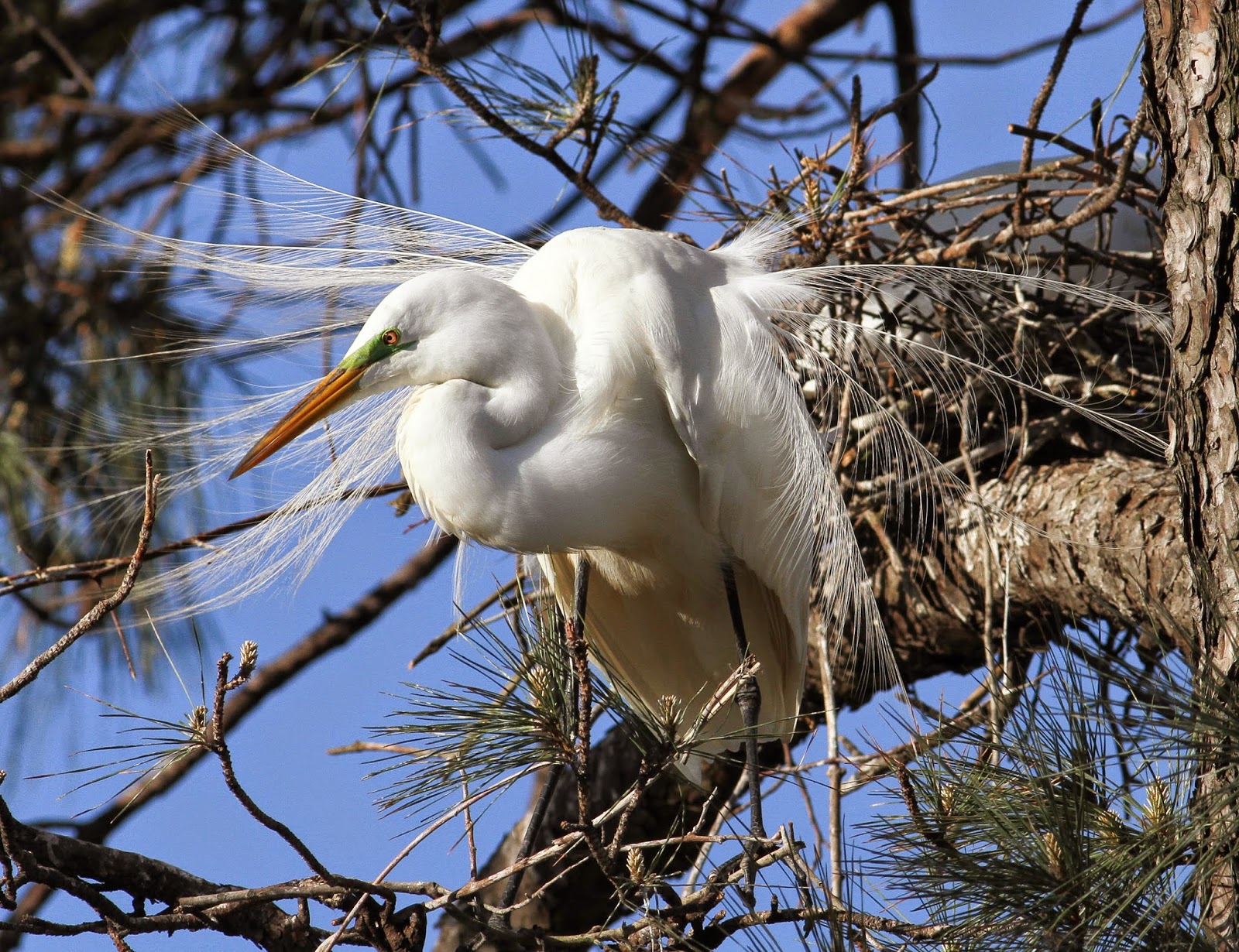
A few Great Egrets (photo above) do winter here in Hampton Roads, but in early spring they are supplemented by more birds that have arrived from the south. Great Egrets are communal breeders, and gather in “rookeries” where they nest literally side by side. It surprises some people to learn that they do nest in trees and not on the ground. They are very loyal to their historic rookeries and return to them year after year.


There is a small rookery in a neighborhood on Indian River Road, and despite “people noise” and heavy traffic, a few egrets cling to the few trees that remain from their larger, historic rookery and they continue to breed there. Neighbors have cut down most of the trees because they don’t like the noise and the mess that the egrets make.


But if you get to the rookery early in the morning, ignore the cars and the McDonalds restaurant close by and just watch the egrets, it’s a beautiful experience. They are in their full breeding finery with long, elegant plumes that they show to their best effect as they try to attract mates. Their lores (the area in front of the eye) turn a beautiful shade of green during this time, which only lasts for a few weeks. Above and below are a few photos of some of these spectacular birds. Special thanks to Nancy Neal for alerting me to the location of this rookery.

Yellow-crowned Night-Herons return to Hampton Roads in late March and early April, and are on their nests by mid-April. Below is a photo of one on its nest, high in a tree near The Hague in Norfolk. I worried for this bird; the winds were so strong, the tree was blowing crazily from side to side, and the nest these birds build look so poorly constructed. But I guess they know what they’re doing; the nest remained intact. The Hague is a good place to find Yellow-crowned Night-Herons. At lower tides, you can see them on the stone wall down at the water for food, and at very low tides, they will hunt on the mudflats for crabs.


I went to Fort Monroe in Hampton with a friend on April 26 to see what birds were there. Surprisingly, one of the first birds we saw in the marina was a late Horned Grebe in full breeding plumage! Most of the wintering grebes have already flown north out of Hampton Roads by late April, but this one was hanging on for a few more days:


A few Brown Pelicans spend the winter in Hampton Roads, but far more join them here in the spring and breed on the islands nearby. Brown pelicans are large and impressive, especially in flight, but their plain brown colors are really rather drab – that is, until it’s breeding season! Look at all the beautiful and subtle colors that this pelican, perched on the pilings at Fort Monroe, has acquired in order to attract a mate!


It was a wet spring, and the flooded grassy fields at Fort Monroe hosted a variety of shorebirds that are usually seen along the mudflats at ponds and wetlands. It was a good opportunity to see various sandpipers, both Yellowlegs, and the spectacular American Oystercatcher, below.


Ospreys, also known as “Fish Hawks,”  are abundant at this time of year, and there were several active nests at Fort Monroe at relatively close range. Here are a couple of photographs I was able to take of these beautiful birds.


One of my favorite places to bird in the spring is the Great Dismal Swamp.  During spring migration, there is no other place I know of that has the amount and variety of bird song that I hear there in the early morning (7-8:00); it’s a veritable symphony! You will not see most of the birds because of the dense woods and foliage along the dike trails, so you must learn to “bird by ear” if you want to identify the species that are singing. I actually find this very rewarding, even though it means not getting many bird photos! I did manage to photograph a pair of Summer Tanagers (below) when I was there earlier this week; the first is an “Orange” female, and the second is a 1st spring male that is molting into his all-red adult plumage.


I tried to go to Mackay Island N.W.R. last weekend, but the refuge was completely closed to traffic due to high water. So I drove around the nearby fields and residential lawns along Muddy Creek Road in Virginia Beach. They were also flooded, which attracted large numbers of Snowy Egrets, Glossy Ibis, and Cattle Egrets, which were nice to see because they have become more scarce in Virginia in recent years. Here’s a photo of one of the strutting, breeding-plumaged Cattle Egrets:


 This is just a taste of the bird activity that is going on around us right now. If you go to any park, pond or woods in the next couple of weeks and just keep your eyes and ears open, I guarantee that you will find something fabulous!


Monday, August 5, 2013

Some Virginia Damselflies


Those of you who read my blog with any regularity know that I’m all about birds, butterflies, dragonflies, and any living creatures that I stumble upon when I’m out exploring nature.  A big part of the experience for me is getting a decent photo of as many different species as I can; it’s gotten to the point where I almost feel like I haven’t seen a critter if I haven’t taken its photo! And in the case of smaller critters, a photograph sometimes becomes essential for the identification process. Damselflies, for instance…

In the last couple of years I have taken a keener interest in damselflies, and have learned so much about them; their life cycles, their field marks, and the surprising number of species that we have in Virginia. I’m constantly trying to learn where to go to find the different species, but this is an ongoing process and I’m still pretty much a beginner. Some damselflies are large enough that they can be seen and identified with the naked eye, but many are so small or so similar to other damselfly species that a photograph is needed to figure out what kind they are.

There are three very general families of damselflies: Broad-winged, Spread-winged, and Pond Damselflies. Broad-winged damselfly species are the largest and most conspicuous of the three families. Almost everyone who has been outdoors has at one time noticed the gorgeous Ebony Jewelwing flying lazily around vegetated edges of shallow waters; it is probably the most common of the Broad-winged Damselflies in our area (photo below). It’s easy to see at the Chesapeake Arboretum at the trailhead in summer.The male has a bright green, iridescent body that reflects different hues in different lights, and opaque black wings.  Another fairly common Broad-winged damselfly in Virginia is the American Rubyspot, one of my favorites. The photo at the top of this blog entry is the male of that species.


The second family of damselflies is the Spreadwings. True to their name, they spread their wings when at rest, rather than holding them over their bodies like the other damselfly families do. I haven’t seen as many Spreadwings as I have the other kinds, but here are photos of two of the species I have seen:

 Slender Spreadwing

Swamp Spreadwing

Pond Damselflies are by far the largest family of damselflies, and they can be further broken down into subfamilies; the “Dancers” are the largest, the “Bluets” are of average damselfly size and are the most numerous (and usually have blue and black field marks), and the “Forktails” are the tiniest  of the damselflies.

Here are some of the "Dancers" you can find in the Hampton Roads area:

Damselflies come in many bright colors, and this male Variable Dancer is one of the most stunning.

 The Blue-fronted Dancer is one of the most common in our region. 

It's easy to spot a Blue-tipped Dancer when it is flying, because that 
bright blue tip on its abdomen is conspicuous as it moves around.

The "Bluets" might be my favorite of the damselflies because there are so many kinds, and identifying them is such a challenge, which I like! Most of them (but not all) have various combinations of black and blues, with minor differences that distinguish them from each other. Here are some examples:

This is not a very good photo, but it illustrates my point. Both of these damselflies are Bluets, but you can easily tell that they are different species if you look closely at their field marks. The one on top is a
 Double-striped Bluet, and the bottom one is a Skimming Bluet.

This one is called an Aurora Damsel. Most bluets have black stripes somewhere along the sides of their thorax, but the Aurora shows solid blue, which helps to identify it.

The Familiar Bluet (above) is probably the most common and widespread damselfly in North America. If you compare this individual to the other bluets, above, you can see differences in the spacing of the blue and black markings on the abdomen, which is a good field mark to use to start the identification process. 

This Turquoise Bluet has no blue markings at all on its abdomen.

The Azure Bluet, above, also has no blue stripes on most of its abdomen, but you can use other small field marks to distinguish it from the Turquoise Bluet and other species; damselfly enthusiasts look at the size and shape of the eyespots, the width of the black stripe on the side of the thorax, the pattern on the abdomen, and the amount of blue at the end of the abdomen, among other things. I know, we're nuts....

Let's look at a few Forktails. These are the smallest of the damselflies and can be very hard to find even when they're out in the open. The Citrine Forktail (photo below) is smaller than a straight pin! To take this photo, I had to sit down in the grass with my macro lens and go through all kinds of contortions that my body wasn't used to -- and I got chigger bites to boot.


The male Rambur's Forktail, below, is one of the more common and widespread Forktails. It's larger than the Citrine, but it's still easy to miss. What usually gets my attention is seeing the two brightly colored parts (the thorax and blue at the end of the abdomen) moving in tandem; the darker parts of the abdomen are harder to see at first, so the bright parts look disconnected.


The tiny Fragile Forktail is also very common here. Below are pictures of the adult male, an adult female, and an immature female. As if damselfly identification isn't hard enough, the sexes and ages of each species are often completely different, as illustrated here: 

Adult male Fragile Forktail. The easiest field mark to look for in the male is the green
 "exclamation point" on the thorax.

Adult female Fragile Forktail

Immature female Fragile Forktail. Note that she has the same bright  "exclamation point" 
on her thorax as the male. Soon her colors will change and she'll look like the adult female 
in the previous photo. If you look very carefully at the adult, you do see a very faded exclamation point on her thorax.

Last, I want to show you one of my favorites, the Duckweed Firetail. This species is found only in ponds where there is Duckweed, and I found a nice little pond at the Dismal Swamp that had several. The Firetail is surprisingly difficult to find despite its outrageous, bright coloration, because of its small size:


I hope you've enjoyed learning a little bit about damselfly identification; I have become thoroughly hooked on these colorful little gems. Next time I'll introduce you to a few Virginia dragonflies. As always, please feel free to contact me at 757-410-7147 if you have any questions, observations, or insights!


Monday, June 3, 2013

Mercurial May

What a strange month May was this year! It seems that every time I had a day off work to go out nature-watching, it was either rainy, cold, windy, or dark and gloomy; none are good conditions for bird photography, and of course butterflies and dragonflies were scarce, if flying at all. Nonetheless, I was able to  visit a few places and take a few photos to share with you.


To start out the month, my aunt from California flew in to Richmond for a couple of Roads Scholars trips (previously named Elderhostel), and I spent the weekend and my birthday with her in Richmond. On Saturday we went to Maymont Park (photo above), but spring had not yet arrived there; it was cold and cloudy. It's a gorgeous park, though, and I intend to go there sometime in the summer; it has lots of possibilities for butterflies and dragonflies.

On Sunday we went on a pontoon boat Bald Eagle tour up the James River with Captain Mike, owner of "Discover the James" (http://www.discoverthejames.com). I highly recommend his trips; his pontoon boat seats six participants and he drives it about seven miles along the James pointing out the wildlife along the way. The focus of our trip was Bald Eagles, and they did not disappoint; we saw about 7 or 8 of them. Mike knows them all and their territories, as he has studied them for years, and knows where to find them. Unfortunately for me, it was another dark and dreary day, and the eagle photos I took are a bit dark and blurred -- but I'll share one anyway. The first photo below is of one of the Bald Eagles in flight clutching a fish, and the second is a Great Blue Heron that has just grabbed a fish that Captain Mike threw its way.


On the home front in Chesapeake, breeding season is in full swing. I have a bird house in my front yard that was investigated early in the month by Chickadees and even Eastern Bluebirds, but in the end a pair of House Wrens won the battle for it, and have built their nest inside; I should hear the babies soon.

Eastern Bluebird male investigating the bird house


One of the House Wrens that won the battle for the bird house.

An interesting fact about House Wrens: the males arrive on their breeding territories earlier than the females, and spend their time building multiple nests to impress the females. When the female arrives, she will hop from nest to nest to nest, and finally pick the one that strikes her fancy. Or desert to the neighboring male if she likes his nests better.

Last fall I posted photos in this blog of some impressive moth caterpillars that friends and neighbors brought to me. I put the caterpillars in my screen cages, and fed them until they went into their cocoon or pupae stages. They overwintered in that stage on my front porch, and two weeks ago one of them, the Polyphemus Moth, emerged! Below is the photo I took last fall of the caterpillar, followed by the moth:


I didn't even realize that the moth had emerged until I noticed two other Polyphemus Moths that were perched on my house near the cages. I then realized that "my" moth had emerged, and she was a female! Females send out their scent, or pheromones, and males can detect that scent from several miles away; the two moths on my house were males that came looking for my female. Here's a picture of one of the males; one of the ways to tell the male and females apart is to look at their antenna. The male's are much "fatter" than the female's (You can click on my photos to get an enlarged version for closer viewing):


By the next day I had five males, so I put them all in the cage with the female, hoping they would breed, which they did:


I should have kept the female in the cage with the leaves of her host plant (Oak), so she could lay her eggs and I could raise more caterpillars; this is what most other butterfly and moth enthusiasts would have done. But the adult Polyphemus Moth, like most of the other large Silk Moth species, lives for only seven days, and I just didn't want her to die in my cage. So I left the cage door open one night and all the moths left to complete their life cycles in the wild.

This is also the time of year that Luna Moths, another of the Silk Moths, emerge from their overwintering cocoons. Below is one that we found on the library's outside brick wall. Like the Polyphemus Moth, Lunas emerge, breed, lay eggs, and die within a 7-day span. They do not eat or drink in the adult stage; their sole purpose is to reproduce.


On a warm day in mid-May, I took a short walk along the Dismal Swamp Canal Trail in Chesapeake. If you haven't been there, you should go check it out. An 8.5-mile multi-use trail runs along the Dismal Swamp Canal, paralleling the old Route 17 to the North Carolina border. It is used by nature lovers, runners, bicyclists, and all manner of outdoor enthusiasts. (Check out the website at  www.cityofchesapeake.net/DSCT). I generally prefer to bird on the less populated west side of the Dismal Swamp, accessed in several places from Suffolk, but the Canal Trail is a nice, quick, easy place to access some of the Swamp's unique habitat if I don't have a lot of time to travel over to Suffolk.

Since the weather was warm, a few butterflies were active, and even though none were unusual species, I enjoyed photographing some "old friends." Here are a few favorites:

 Red-spotted Purple Butterfly
A lot of our swallowtail species also have black-with-blue coloration, but note that the 
Red-spotted Purple does not have the "tails" that the Swallowtails do.

 Zebra Swallowtail

 Tiger Swallowtails mineraling 

Spicebush Swallowtail

Blue-Gray Gnatcatcher


I threw in the photo of the Gnatcatcher because I've been trying, unsuccessfully, to get a decent photo of one, and I finally did. These tiny little birds are almost everywhere in the spring and summer months, and you've undoubtedly heard them even if you didn't know it; they have a soft wheezy, nasally, rambling song. These little guys are very active, like Kinglets, and are usually flitting about high up in a tree. They are also very curious; if you make "pishing" sounds, they will usually come in closer to investigate you, which is what the one in my photo did.

So, here comes summer now, and I hope that the excessive rains we had in May finally cease! If they do, I'll be out looking for birds and insects to photograph at Mackay Island, Piney Grove, Back Bay, Maymont Park, and hopefully some places in the Piedmont and in the Blue Ridge; the more different kinds of habitat you visit, the more possible species there are to find. I'll let you know what I saw next time, and if you want to share your own sitings with me, please feel free to comment. Or better yet, bring your photos to my next "Nature Photo Night" at the Chesapeake Central Library, which will be on Monday, July 29 at 6:00 p.m. Call me at 410-7147 if you would like more information about this -- ask for Karen.

Saturday, May 11, 2013

A Mid-April Colorado Birding Trip


On April 13 I flew to Denver to join up with a group of nine other Virginia birders for a one-week birding extravaganza covering the whole state of Colorado. Our leader carefully planned our daily itineraries which centered around seeing as many bird species as possible, with a big emphasis on seeing rare birds and western “specialties” that we do not see on the Atlantic coast. Most of us had targeted several “life birds,” which are species that one has never seen before. Life birds are the Holy Grail of birdwatching, and obviously the longer you have birded and the more species you have seen, the more difficult it is to find and see a new life bird. That’s the advantage of joining up with a group led by an experienced leader who does all the work, figuring out where and when to go to have the best chance of seeing the rare or hard-to-find species.

We certainly experienced ups and downs during the week; the “ups” included all the great birds and scenery that we did see, the fellowship with the other birders and making new friends, and for me, just being back “out west” where I was raised and where my heart is. The “down” was a big one, though; the weather had a huge impact on the trip and made it impossible to go to many of the places we had planned to bird.


We started in the far southeastern corner of Colorado in prairie and grassland habitat, where temperatures were cool but at least there was no snow, and roads were passable. Our first early morning stop at a Lesser Prairie Chicken lek produced one lone bird that was quite far away from our blind and did not remain long, but it was the first life bird of the trip for most of us. Other birds typical of this habitat included the bird pictured above, the Long-billed Curlew, and below, the Greater Roadrunner.


We drove then to the western part of the state where we started to see the first signs of snow in the higher elevations; it was just beautiful and all the roads were still passable. We visited Gunnison National Park and Colorado National Monument, which are both near Grand Junction, close to the Utah border. Both places were stunning; here is a photo of  the Black Canyon at Gunnison N.P.:


We hoped to see a Dusky Grouse at Gunnison, and we drove slowly along the roads in the morning hoping to find one along the shoulder of the road. All grouse species are notoriously difficult to find away from their leks, like trying to find a needle in a haystack, but our leader was successful in finding a Dusky for us – here it is:


Colorado National Monument is a gem of a place that few people know about; it’s like a mini Grand Canyon with gorgeous red rock formations and canyons. The weather had turned darker and drizzly by the time we got there, but we walked around and found some of the common bird species like Spotted Towhee, Juniper Titmouse and Say’s Phoebe. Here are a couple of snapshots of the views there:


Our next destinations were in northern Colorado, where we ran into some major weather. Everything was blanketed in snow, so our best chance of finding any birds for the next few days was to visit bird feeders  where we had great success. Here are some of my favorites:


I've only seen Common Redpolls (above and below) once in all my years of birding, so seeing them in good numbers at the feeders was a real treat. Redpolls are northern finches that move south into the lower 48 in the winter, but they are usually restricted to the northern tier of states and are somewhat unpredictable in their occurrence. They usually wander around in groups eating from the seed heads of thistles and other seed-bearing plants, but since all of those plants were covered by the snow, they took advantage of the niger seed that people put in their feeders. Just look at this group!--


Another of my favorites is a bird of high elevations and northern states, the Pine Grosbeak. We do not see them in Virginia; they occur far to the north of us. Pine Grosbeaks are actually a large species of finch; here is a beautiful male:


Below is a Mountain Chickadee, a bird of the western mountains. It is a "cousin" to southeast Virginia's Carolina Chickadee. My roommate liked this photo and thought we should caption it "Take that, Bluebird!"


In the eastern states we get Red-winged Blackbirds, but not Yellow-headed Blackbirds. Here is a photo of one of each (males), looking annoyed with with weather -- (or maybe they're annoyed with me?)


And one last feeder bird that I must share with you, because it was a life bird for me. The Brown-capped Rosy Finch occurs almost exclusively in Colorado, and loves high altitudes, snow and freezing temperatures. We certainly had all of the above that week, and we saw hundreds of these little guys at various feeders.


This has been just a thumbnail sketch of our trip, but I hope it gives you a little taste of Colorado birding and nature. I would love to go there again in less extreme weather -- as I indicated, there were many places we could not go, and birds we could not see. We were there during the worst snowstorm Colorado has had in three years, and no one could have predicted that. We actually did drive up to Loveland Pass hoping we could search for Ptarmigan, but it was minus 12 degrees there plus 60 mph winds with stronger gusts. It was almost a complete whiteout; in fact, five snowboarders tragically died there in an avalanche the next day. 

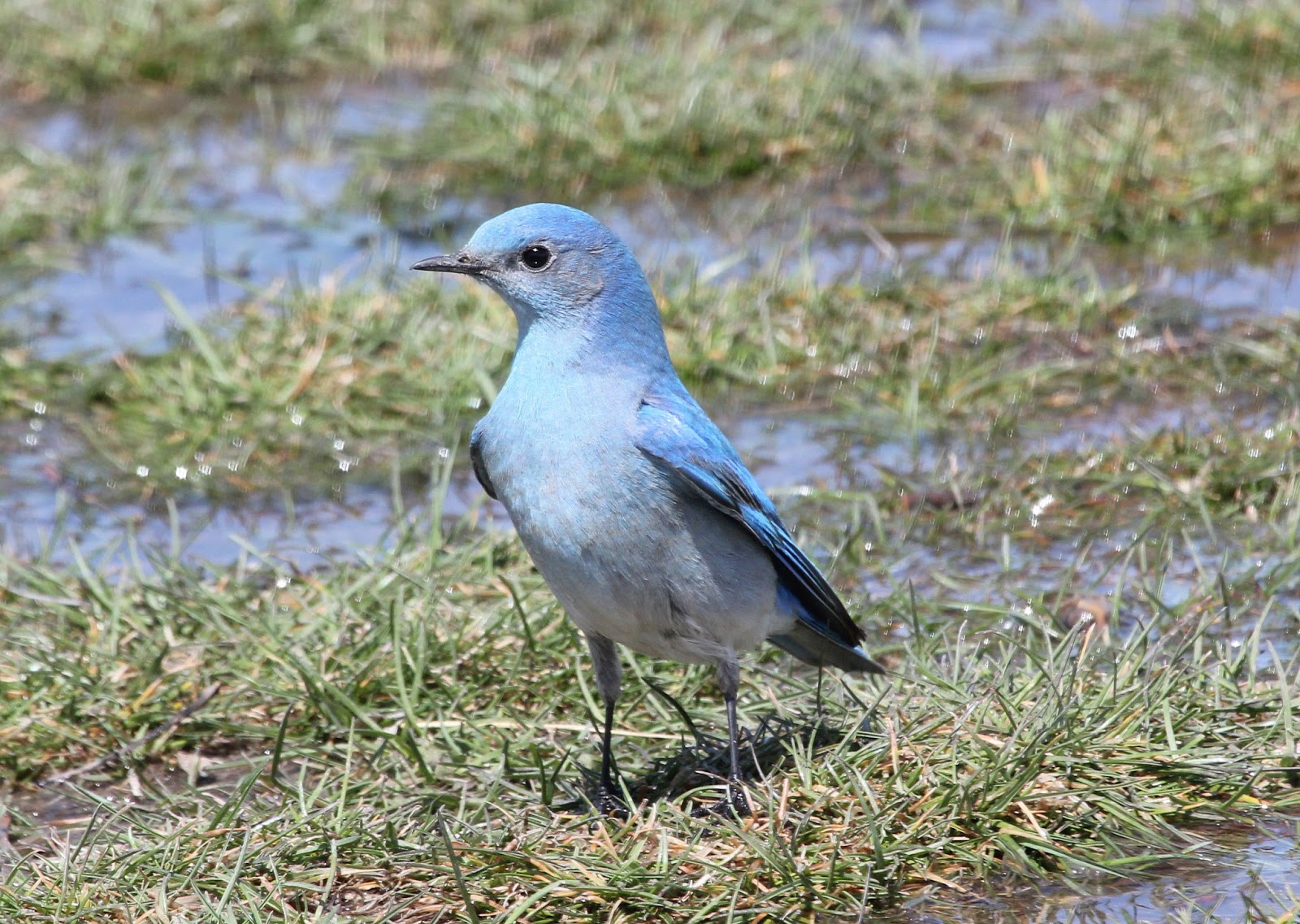
But focusing on the positive side, we saw a lot of gorgeous places and beautiful birds, and I will end with a photo of one of the most beautiful, a male Mountain Bluebird. What more is there to say?