Showing posts with label Virginia. Show all posts

Thursday, May 8, 2014

Some Spring Birding in Hampton Roads

Springtime is a very active time of year for birds and bird watchers. Most of the winter birds and waterfowl have left Hampton Roads to head north to their breeding grounds, but there are new arrivals every day of birds that spent their winter south of us and are returning north to their breeding grounds. Some stay in Virginia to breed, like the industrious little Barn Swallow, above, that is collecting mud and sticks for its nest, and some species are just passing through our area as they continue to their breeding grounds further north of us. For bird watchers, every day is an adventure, and no two days are the same. Here are some of the bird photos I’ve taken this April and so far in May.


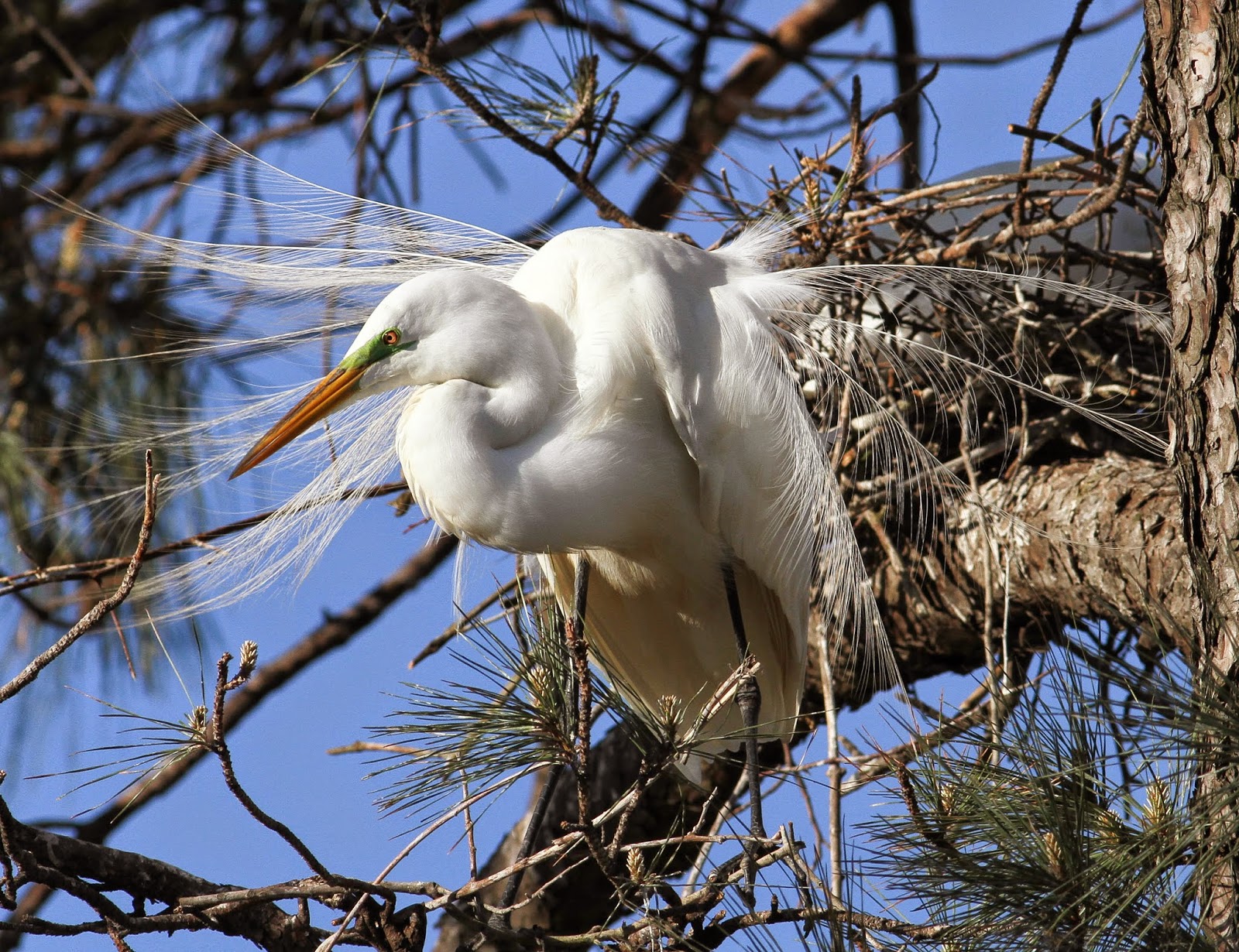
A few Great Egrets (photo above) do winter here in Hampton Roads, but in early spring they are supplemented by more birds that have arrived from the south. Great Egrets are communal breeders, and gather in “rookeries” where they nest literally side by side. It surprises some people to learn that they do nest in trees and not on the ground. They are very loyal to their historic rookeries and return to them year after year.


There is a small rookery in a neighborhood on Indian River Road, and despite “people noise” and heavy traffic, a few egrets cling to the few trees that remain from their larger, historic rookery and they continue to breed there. Neighbors have cut down most of the trees because they don’t like the noise and the mess that the egrets make.


But if you get to the rookery early in the morning, ignore the cars and the McDonalds restaurant close by and just watch the egrets, it’s a beautiful experience. They are in their full breeding finery with long, elegant plumes that they show to their best effect as they try to attract mates. Their lores (the area in front of the eye) turn a beautiful shade of green during this time, which only lasts for a few weeks. Above and below are a few photos of some of these spectacular birds. Special thanks to Nancy Neal for alerting me to the location of this rookery.

Yellow-crowned Night-Herons return to Hampton Roads in late March and early April, and are on their nests by mid-April. Below is a photo of one on its nest, high in a tree near The Hague in Norfolk. I worried for this bird; the winds were so strong, the tree was blowing crazily from side to side, and the nest these birds build look so poorly constructed. But I guess they know what they’re doing; the nest remained intact. The Hague is a good place to find Yellow-crowned Night-Herons. At lower tides, you can see them on the stone wall down at the water for food, and at very low tides, they will hunt on the mudflats for crabs.


I went to Fort Monroe in Hampton with a friend on April 26 to see what birds were there. Surprisingly, one of the first birds we saw in the marina was a late Horned Grebe in full breeding plumage! Most of the wintering grebes have already flown north out of Hampton Roads by late April, but this one was hanging on for a few more days:


A few Brown Pelicans spend the winter in Hampton Roads, but far more join them here in the spring and breed on the islands nearby. Brown pelicans are large and impressive, especially in flight, but their plain brown colors are really rather drab – that is, until it’s breeding season! Look at all the beautiful and subtle colors that this pelican, perched on the pilings at Fort Monroe, has acquired in order to attract a mate!


It was a wet spring, and the flooded grassy fields at Fort Monroe hosted a variety of shorebirds that are usually seen along the mudflats at ponds and wetlands. It was a good opportunity to see various sandpipers, both Yellowlegs, and the spectacular American Oystercatcher, below.


Ospreys, also known as “Fish Hawks,”  are abundant at this time of year, and there were several active nests at Fort Monroe at relatively close range. Here are a couple of photographs I was able to take of these beautiful birds.


One of my favorite places to bird in the spring is the Great Dismal Swamp.  During spring migration, there is no other place I know of that has the amount and variety of bird song that I hear there in the early morning (7-8:00); it’s a veritable symphony! You will not see most of the birds because of the dense woods and foliage along the dike trails, so you must learn to “bird by ear” if you want to identify the species that are singing. I actually find this very rewarding, even though it means not getting many bird photos! I did manage to photograph a pair of Summer Tanagers (below) when I was there earlier this week; the first is an “Orange” female, and the second is a 1st spring male that is molting into his all-red adult plumage.


I tried to go to Mackay Island N.W.R. last weekend, but the refuge was completely closed to traffic due to high water. So I drove around the nearby fields and residential lawns along Muddy Creek Road in Virginia Beach. They were also flooded, which attracted large numbers of Snowy Egrets, Glossy Ibis, and Cattle Egrets, which were nice to see because they have become more scarce in Virginia in recent years. Here’s a photo of one of the strutting, breeding-plumaged Cattle Egrets:


 This is just a taste of the bird activity that is going on around us right now. If you go to any park, pond or woods in the next couple of weeks and just keep your eyes and ears open, I guarantee that you will find something fabulous!


Monday, August 5, 2013

Some Virginia Damselflies


Those of you who read my blog with any regularity know that I’m all about birds, butterflies, dragonflies, and any living creatures that I stumble upon when I’m out exploring nature.  A big part of the experience for me is getting a decent photo of as many different species as I can; it’s gotten to the point where I almost feel like I haven’t seen a critter if I haven’t taken its photo! And in the case of smaller critters, a photograph sometimes becomes essential for the identification process. Damselflies, for instance…

In the last couple of years I have taken a keener interest in damselflies, and have learned so much about them; their life cycles, their field marks, and the surprising number of species that we have in Virginia. I’m constantly trying to learn where to go to find the different species, but this is an ongoing process and I’m still pretty much a beginner. Some damselflies are large enough that they can be seen and identified with the naked eye, but many are so small or so similar to other damselfly species that a photograph is needed to figure out what kind they are.

There are three very general families of damselflies: Broad-winged, Spread-winged, and Pond Damselflies. Broad-winged damselfly species are the largest and most conspicuous of the three families. Almost everyone who has been outdoors has at one time noticed the gorgeous Ebony Jewelwing flying lazily around vegetated edges of shallow waters; it is probably the most common of the Broad-winged Damselflies in our area (photo below). It’s easy to see at the Chesapeake Arboretum at the trailhead in summer.The male has a bright green, iridescent body that reflects different hues in different lights, and opaque black wings.  Another fairly common Broad-winged damselfly in Virginia is the American Rubyspot, one of my favorites. The photo at the top of this blog entry is the male of that species.


The second family of damselflies is the Spreadwings. True to their name, they spread their wings when at rest, rather than holding them over their bodies like the other damselfly families do. I haven’t seen as many Spreadwings as I have the other kinds, but here are photos of two of the species I have seen:

 Slender Spreadwing

Swamp Spreadwing

Pond Damselflies are by far the largest family of damselflies, and they can be further broken down into subfamilies; the “Dancers” are the largest, the “Bluets” are of average damselfly size and are the most numerous (and usually have blue and black field marks), and the “Forktails” are the tiniest  of the damselflies.

Here are some of the "Dancers" you can find in the Hampton Roads area:

Damselflies come in many bright colors, and this male Variable Dancer is one of the most stunning.

 The Blue-fronted Dancer is one of the most common in our region. 

It's easy to spot a Blue-tipped Dancer when it is flying, because that 
bright blue tip on its abdomen is conspicuous as it moves around.

The "Bluets" might be my favorite of the damselflies because there are so many kinds, and identifying them is such a challenge, which I like! Most of them (but not all) have various combinations of black and blues, with minor differences that distinguish them from each other. Here are some examples:

This is not a very good photo, but it illustrates my point. Both of these damselflies are Bluets, but you can easily tell that they are different species if you look closely at their field marks. The one on top is a
 Double-striped Bluet, and the bottom one is a Skimming Bluet.

This one is called an Aurora Damsel. Most bluets have black stripes somewhere along the sides of their thorax, but the Aurora shows solid blue, which helps to identify it.

The Familiar Bluet (above) is probably the most common and widespread damselfly in North America. If you compare this individual to the other bluets, above, you can see differences in the spacing of the blue and black markings on the abdomen, which is a good field mark to use to start the identification process. 

This Turquoise Bluet has no blue markings at all on its abdomen.

The Azure Bluet, above, also has no blue stripes on most of its abdomen, but you can use other small field marks to distinguish it from the Turquoise Bluet and other species; damselfly enthusiasts look at the size and shape of the eyespots, the width of the black stripe on the side of the thorax, the pattern on the abdomen, and the amount of blue at the end of the abdomen, among other things. I know, we're nuts....

Let's look at a few Forktails. These are the smallest of the damselflies and can be very hard to find even when they're out in the open. The Citrine Forktail (photo below) is smaller than a straight pin! To take this photo, I had to sit down in the grass with my macro lens and go through all kinds of contortions that my body wasn't used to -- and I got chigger bites to boot.


The male Rambur's Forktail, below, is one of the more common and widespread Forktails. It's larger than the Citrine, but it's still easy to miss. What usually gets my attention is seeing the two brightly colored parts (the thorax and blue at the end of the abdomen) moving in tandem; the darker parts of the abdomen are harder to see at first, so the bright parts look disconnected.


The tiny Fragile Forktail is also very common here. Below are pictures of the adult male, an adult female, and an immature female. As if damselfly identification isn't hard enough, the sexes and ages of each species are often completely different, as illustrated here: 

Adult male Fragile Forktail. The easiest field mark to look for in the male is the green
 "exclamation point" on the thorax.

Adult female Fragile Forktail

Immature female Fragile Forktail. Note that she has the same bright  "exclamation point" 
on her thorax as the male. Soon her colors will change and she'll look like the adult female 
in the previous photo. If you look very carefully at the adult, you do see a very faded exclamation point on her thorax.

Last, I want to show you one of my favorites, the Duckweed Firetail. This species is found only in ponds where there is Duckweed, and I found a nice little pond at the Dismal Swamp that had several. The Firetail is surprisingly difficult to find despite its outrageous, bright coloration, because of its small size:


I hope you've enjoyed learning a little bit about damselfly identification; I have become thoroughly hooked on these colorful little gems. Next time I'll introduce you to a few Virginia dragonflies. As always, please feel free to contact me at 757-410-7147 if you have any questions, observations, or insights!


Wednesday, March 27, 2013

Winter Birds At My Chesapeake Yard

  
No question, I see a lot more birds at my Chesapeake bird feeders in the winter than I do in the other seasons. In the warm seasons, many of the birds we see are insect-eaters and do not use bird feeders that offer seeds. And the seed-eaters can find all the food they want naturally, and are less dependent on our feeders. In the winter, food is harder to find; the insect-eaters have migrated south to warmer climates that still have insects, and the seed-eaters rely more on the easy pickin's at the local bird feeder. Winter can be the most interesting time to "feeder watch."

I had an interesting winter in my own yard this year, and I hosted some species that don't come to my yard every year. Winter birds are far less predictable than breeding birds which remain pretty much the same year-to-year. Weather patterns and food sources to the north of us affect bird movements greatly in the fall and winter, and many of the birds we see during those seasons are migrants that do not necessarily return to the same locations each year like the summer breeding birds do. Each day can bring something new and unexpected.

My first real surprise of the winter was the female Painted Bunting that visited my yard for a week or so (below). The male Painted Bunting is well known for its bright and showy colors; bright blue, red, green and yellow; the female's colors are subtle shades of green. Painted Buntings are very uncommon in Virginia, but a few seem to stray here from the southern states each year. I have seen three or four in my yard over the years, including one gorgeous male.

 
       (Here is the male bird for comparison, courtesy of  floridabirdingtrail.com)


This winter was an "irruption" year for many northern species of songbird. When cone crops and other food sources are poor in the northern states, birds that usually winter in those regions move south in search of food. An "irruption" year is one in which large numbers of these birds occur in more southern states; a few of these birds might be seen most years, but in irruption years they are conspicuous and can be quite common. The three birds below were much more common this year than in non-irruption years:


Pine Siskins are little finches about the same size as American Goldfinches, a species that they often associate with in "feeding flocks." Pine Siskins are a streaky little brown bird with variable amounts of yellow coloring in the wings. I've had anywhere from two to two dozen at my feeders all winter.


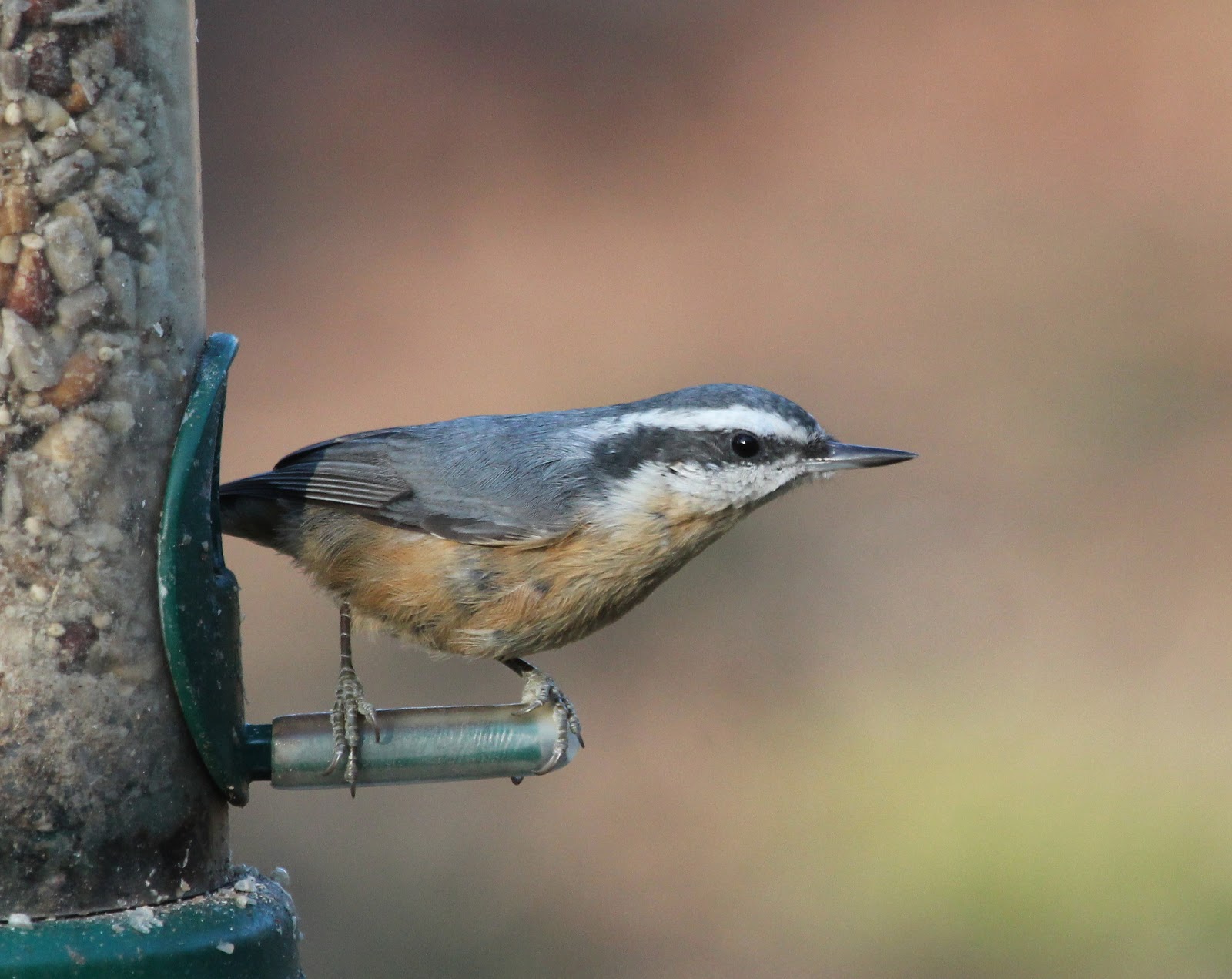
Red-breasted Nuthatches move through eastern Virginia each fall in varying numbers; the Eastern Shore is a reliable place to find a few. They do not usually stay here or visit our bird feeders, but during irruption years like this one they have been common. They are daily visitors to my feeders.


If you keep a feeder, or even if you are just a casual bird watcher, you are familiar with our resident House Finches; the males have red markings, and the females and juveniles are plain birds with blurry brown streaking. The bird in the photos above is similar to the female House Finch, but is its "cousin," a female Purple Finch, which is a separate species (note the distinct whitish stripes above and below the bird's eye; this is a reliable field mark for distinguishing the two female finches). Purple Finches do not breed in southeast Virginia, but a few do pass through during the southbound fall migration (mostly to the west of us), and some visit bird feeders. This is only the second Purple Finch I've ever seen at my feeder.


Remember this guy? Last year I wrote in this blog about the six Baltimore Orioles that spent the winter in my yard. I had kept a hummingbird feeder filled with sugar water outside during the late fall, hoping to attract a rare winter hummingbird, but instead I noticed one day that a Baltimore Oriole was drinking from the feeder. I knew that Baltimore Orioles love to eat grape jelly, so I immediately went out and bought some jelly and a feeder to put it in. Within a few weeks, I had a total of six orioles, and they spent the entire winter with me, which is very uncommon here. They must have remembered my yard and my grape jelly, because this winter  they returned; in fact they added a member to their group. All seven Orioles are still with me as of today.


All sparrows look alike to most people -- "little brown jobs," as they're called. But this one, a Fox Sparrow (above),  is special to me. Although this species does winter in our region, it is usually not seen in suburban yards; they prefer woods and unpopulated places. But this one spent two months in my yard this winter.


The bird above is also a species of sparrow, although it does not look like most sparrows at all. It is a member of the Towhee family, and this species is an Eastern Towhee. Eastern Towhees are quite common in our area, but for some reason they do not often frequent my yard even when there is free food. This year was the exception, as at least two visit me daily.


 Pine Warblers (above) are a relatively plain member of the Warbler family of birds, but in the winter they bring a much appreciated splash of color to a dreary day. They frequently come to my yard for the suet and nuts that I put out. Pine Warblers are year-round residents in southeast Virginia, and one of only two warblers that commonly winter here; the winter-plumage Yellow-rumped Warbler, below, is the other.


If you have busy bird feeders as I do, you will eventually attract one or several of the Accipiters, known commonly as "bird hawks." Accipiters do prey on small birds, and they are often much maligned for this, but they need to eat too and it's all part of the natural cycle and survival of the fittest. There are two species of Accipiter that you are likely to see in this area, the Sharp-shinned Hawk and the Cooper's Hawk. They are extremely similar in appearance, and even though there is an "average" size difference between them, there is much overlap; the average Cooper's Hawk is larger than the average Sharp-shinned Hawk, but since female hawks are larger than males, a male Cooper's Hawk might in fact be smaller than a female Sharp-shinned. Confused? Even the most experienced birder can have an extremely difficult time identifying those birds in the overlap range. It takes a lot of experience and familiarity with the more subtle field marks to be able to distinguish these two species.


This bird is a first-year, or juvenile, Sharp-shinned Hawk. It is just starting to acquire some of its adult feathers on its breast. Compared to the Cooper's Hawk, it has a smaller-looking head, a shorter and squared-off tail, and it has a "puffed chest" appearance, seeming to carry the bulk of its weight in the chest.


This is a Cooper's Hawk that is almost in its adult plumage. The Sharp-shinned Hawk will have the same plumage in its adult stage, so don't try to ID these two birds based on their color; one is juvenile and one is adult. But if you look at the overall "feel" of this Cooper's Hawk, you can see that its tail is longer than the Sharp-shinned's and is rounded at the bottom rather than squared. The white tipping on the tail is also more in evidence than it is with the Sharp-shinned. The Cooper's head is larger in proportion to its body, and the entire posture of the body is just longer. Rather than looking "puffy-chested" like the Sharp-shinned, the Cooper's seems to carry more of its weight lower in the belly.

There are other things to look for when identifying these two hawks; a good website with concise, helpful  information is http://www.birds.cornell.edu/pfw/AboutBirdsandFeeding/accipiterIDtable.htm.

Next month we will have another Nature Photo Night at the Chesapeake Central Library, so pencil in the date if you'd like to join us: Monday, April 29 starting at 6:00 p.m.  Bring about 20 of your nature or wildlife photos on a USB device or a CD, and we will project them onto the library's movie screen for everyone to view and discuss. All levels of expertise are welcome to come, and if you'd rather just look at the photos than show your own, that is fine too. Give me a call at 757-410-7141 if you have any questions or would like more information -- ask for Karen.


Wednesday, August 31, 2011

Fall Bird Migration Is Underway! A Day at Bethel Beach

Migrant birds fly north in the spring and south for the winter, right? You might be surprised to learn that the southbound fall migration for some birds actually begins in July, in the heart of what we in North America call “summer.” Most of these July migrants are of the shorebird family of birds. These earliest migrants are actually the adult shorebirds that migrated north in the spring to Canada or the Arctic to breed. Almost immediately after their young fledge, these same adults abandon them and begin their southward migrations. The young birds are left behind to fend for themselves for a few weeks and figure out for themselves how to survive and how and where to migrate! Most of the shorebirds we see after mid-August are these hatch-year birds, riding the second “wave” of migration after their parents. How they know where to go and how to get there is one of those profound miracles of nature.

The shorebird family is a very diverse one that includes species that range from the 4-5” sandpipers (also known affectionately by birders as “peeps”) to the 26” Long-billed Curlew. The Long-billed Curlew is a western species that we do not see here on the east coast; the largest shorebird that we’re likely to see here is the 19" Marbled Godwit. The photograph at the beginning of this blog entry is a Marbled Godwit; contrast this bird with the tiny Semipalmated Sandpipers, below.


Also conspicuous on the Virginia beaches in August is the tern migration. Terns are in the same family of birds as gulls, but are generally more sleek and streamlined than gulls are. Many species sport a black cap or crest in breeding plumage that fades away as fall approaches; they are much less striking in their winter plumage. Terns are the white birds that you see flying over bodies of water with their heads down looking for small fish, then diving straight down, bill first, to catch that meal. Terns come in all sizes too, from the 9” Least Tern to the 21” Caspian Tern.


From left to right: Sandwich tern (with the yellow bill tip), Forster’s Tern, and the orange-billed Royal Tern, which is almost as big as the Caspian.

I went to Bethel Beach on August 18 in hopes of finding some of these early fall migrants, and I was not disappointed. Bethel Beach is near the town of Matthews, on the Middle Neck of Virginia, on the west side of the Chesapeake Bay. Once you get to Bethel Beach you can walk southbound along the beach until you reach a sandy "hook" where the beach ends. At the end of this hook I found five different species of terns, and several species of shorebirds. I took all the photos in this blog entry on that day; here are some more:


The shorebirds above and below are Short-billed Dowitchers, migrants along our waterways. There is a Long-billed Dowitcher too, very similar in appearance to the Short-billed and it's often impossible to tell the two apart; contrary to the implication in their names, the bill sizes overlap and cannot usually be relied upon as the only identifier. You'll find dowitchers probing the mudflats and shallow waters with their long bills, looking for food.


One of the subfamilies of shorebirds is the Plovers. They are usually easy to tell apart from other shorebirds by their smallish size, very rounded appearance and very short bills among other things. They hunt by sight, rather than by feel, as longer-billed shorebirds like dowitchers do. Below is a common migrant along our coast, the Semipalmated Plover. A plover that you might be more familiar with is its "cousin" the Killdeer, which is a permanent resident throughout North America. Killdeers are larger than semipalmated Plovers and have two dark chest stripes instead of one; they are also famous for their "broken wing" display, which they perform as a distraction if they believe their chicks are threatened.


Semipalmated Plover at Bethel Beach


Killdeer for comparison with the Semipalmated Plover.

Here are two Least Terns; as mentioned above, they are our smallest Tern, measuring about 9" from tail tip to bill tip. They are a threatened species, mostly due to loss of habitat. They nest on open beaches and sandy places, where they have to compete with humans in a mostly losing battle for habitat. Fortunately there are some nature preserves that block human access during their breeding season, which allows the terns to successfully reproduce.


The medium-sized Sandwich Terns, below, also migrate down the Atlantic coast in August. These two at Bethel Beach are mostly in their winter plumage. Note their yellow bill tips; if you can get close enough to them to see this field mark, you can make a positive identification of this species.


The Seaside Dragonlet (below) is our only saltwater species of dragonfly, and at this time of year they are abundant along the beaches. The individual below is a female; note the numerous tiny stripes on her thorax. The adult male is entirely dark blue, almost blackish in appearance.


Bethel Beach was also a fantastic spot to see Ospreys and Bald Eagles, roosting in the nearby scrub and trees or soaring as they hunted for prey.


Osprey

This bird is not yet a fully-grown adult Bald Eagle; it takes eagles four years to acquire the all-white head and tail for which they are well known.

As we move into September, the numbers of shorebirds and terns will decrease as they continue south to their wintering grounds, but numbers of other kinds of birds will increase. One of the most anticipated times of year on the Virginia birder's calendar is September, when the bulk of songbirds migrate along our Atlantic Flyway. We will soon see orioles, tanagers, flycatchers, warblers, vireos and many others moving through, and one of the best places to witness this migration is along the southern tip of Virginia's Eastern Shore. Places like the Eastern Shore National Wildlife Refuge and Kiptopeke State Park are traditional hotspots where birders gather in the morning and hope for a "fallout" of these birds. By mid-September and well into October and even November, the hawk and eagle migrations will be at their peak. I will be out there for the next couple of months as often as my work schedule and my pocketbook allow, and I hope I will find a lot of good things to share with you. Until next time, take a little time to enjoy the bountiful nature and wildlife that we are so fortunate to have here, in and near Chesapeake.