Showing posts with label Virginia birds. Show all posts

Thursday, May 8, 2014

Some Spring Birding in Hampton Roads

Springtime is a very active time of year for birds and bird watchers. Most of the winter birds and waterfowl have left Hampton Roads to head north to their breeding grounds, but there are new arrivals every day of birds that spent their winter south of us and are returning north to their breeding grounds. Some stay in Virginia to breed, like the industrious little Barn Swallow, above, that is collecting mud and sticks for its nest, and some species are just passing through our area as they continue to their breeding grounds further north of us. For bird watchers, every day is an adventure, and no two days are the same. Here are some of the bird photos I’ve taken this April and so far in May.


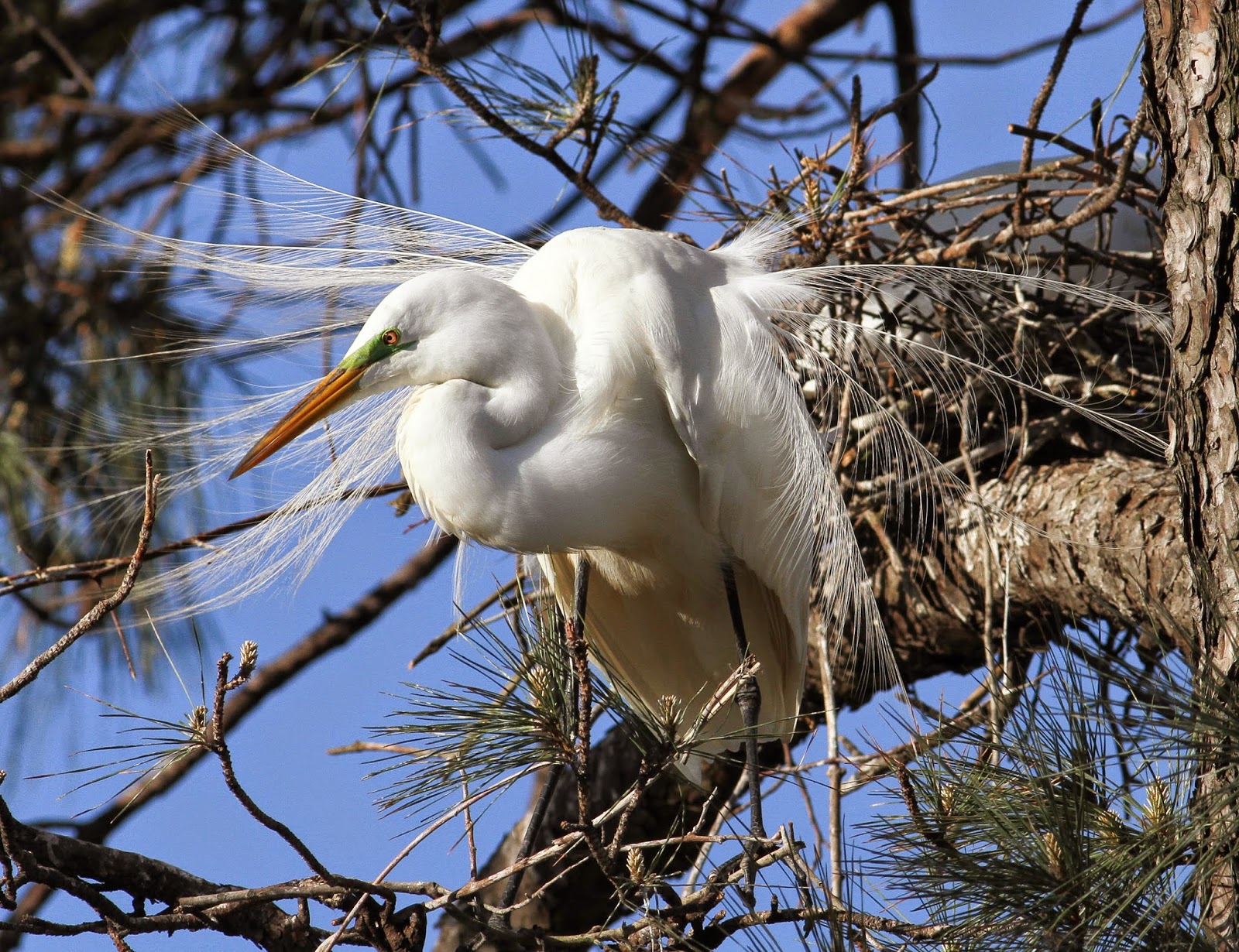
A few Great Egrets (photo above) do winter here in Hampton Roads, but in early spring they are supplemented by more birds that have arrived from the south. Great Egrets are communal breeders, and gather in “rookeries” where they nest literally side by side. It surprises some people to learn that they do nest in trees and not on the ground. They are very loyal to their historic rookeries and return to them year after year.


There is a small rookery in a neighborhood on Indian River Road, and despite “people noise” and heavy traffic, a few egrets cling to the few trees that remain from their larger, historic rookery and they continue to breed there. Neighbors have cut down most of the trees because they don’t like the noise and the mess that the egrets make.


But if you get to the rookery early in the morning, ignore the cars and the McDonalds restaurant close by and just watch the egrets, it’s a beautiful experience. They are in their full breeding finery with long, elegant plumes that they show to their best effect as they try to attract mates. Their lores (the area in front of the eye) turn a beautiful shade of green during this time, which only lasts for a few weeks. Above and below are a few photos of some of these spectacular birds. Special thanks to Nancy Neal for alerting me to the location of this rookery.

Yellow-crowned Night-Herons return to Hampton Roads in late March and early April, and are on their nests by mid-April. Below is a photo of one on its nest, high in a tree near The Hague in Norfolk. I worried for this bird; the winds were so strong, the tree was blowing crazily from side to side, and the nest these birds build look so poorly constructed. But I guess they know what they’re doing; the nest remained intact. The Hague is a good place to find Yellow-crowned Night-Herons. At lower tides, you can see them on the stone wall down at the water for food, and at very low tides, they will hunt on the mudflats for crabs.


I went to Fort Monroe in Hampton with a friend on April 26 to see what birds were there. Surprisingly, one of the first birds we saw in the marina was a late Horned Grebe in full breeding plumage! Most of the wintering grebes have already flown north out of Hampton Roads by late April, but this one was hanging on for a few more days:


A few Brown Pelicans spend the winter in Hampton Roads, but far more join them here in the spring and breed on the islands nearby. Brown pelicans are large and impressive, especially in flight, but their plain brown colors are really rather drab – that is, until it’s breeding season! Look at all the beautiful and subtle colors that this pelican, perched on the pilings at Fort Monroe, has acquired in order to attract a mate!


It was a wet spring, and the flooded grassy fields at Fort Monroe hosted a variety of shorebirds that are usually seen along the mudflats at ponds and wetlands. It was a good opportunity to see various sandpipers, both Yellowlegs, and the spectacular American Oystercatcher, below.


Ospreys, also known as “Fish Hawks,”  are abundant at this time of year, and there were several active nests at Fort Monroe at relatively close range. Here are a couple of photographs I was able to take of these beautiful birds.


One of my favorite places to bird in the spring is the Great Dismal Swamp.  During spring migration, there is no other place I know of that has the amount and variety of bird song that I hear there in the early morning (7-8:00); it’s a veritable symphony! You will not see most of the birds because of the dense woods and foliage along the dike trails, so you must learn to “bird by ear” if you want to identify the species that are singing. I actually find this very rewarding, even though it means not getting many bird photos! I did manage to photograph a pair of Summer Tanagers (below) when I was there earlier this week; the first is an “Orange” female, and the second is a 1st spring male that is molting into his all-red adult plumage.


I tried to go to Mackay Island N.W.R. last weekend, but the refuge was completely closed to traffic due to high water. So I drove around the nearby fields and residential lawns along Muddy Creek Road in Virginia Beach. They were also flooded, which attracted large numbers of Snowy Egrets, Glossy Ibis, and Cattle Egrets, which were nice to see because they have become more scarce in Virginia in recent years. Here’s a photo of one of the strutting, breeding-plumaged Cattle Egrets:


 This is just a taste of the bird activity that is going on around us right now. If you go to any park, pond or woods in the next couple of weeks and just keep your eyes and ears open, I guarantee that you will find something fabulous!


Monday, December 30, 2013

Snowy Owls: The Invasion of the Century!


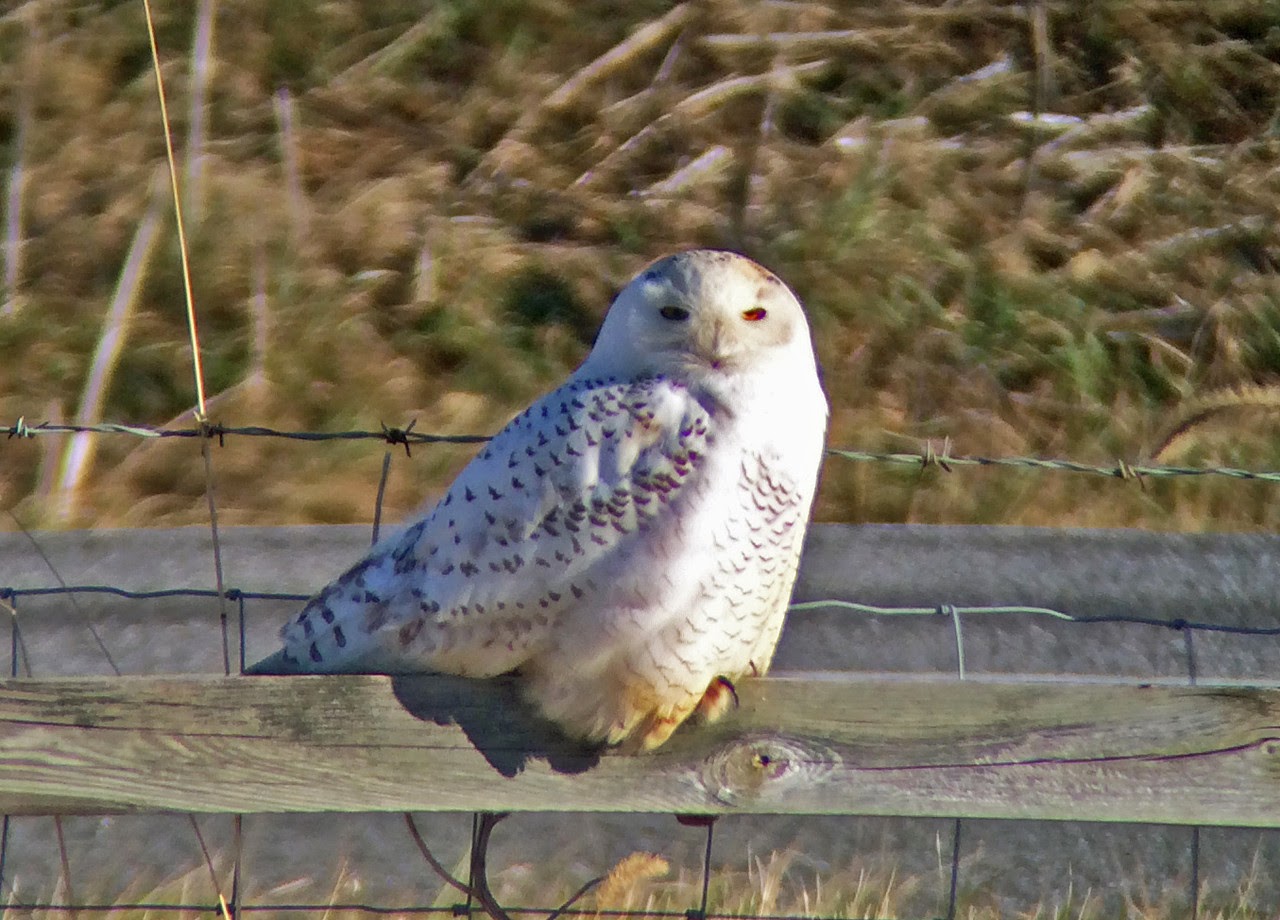
Even if you're not a birder, you probably know what a Snowy Owl looks like. Harry Potter's owl Hedwig is a Snowy Owl, a huge white owl with bright golden yellow eyes. Snowies are Arctic birds that are at home on the arctic tundra and are not often seen in the lower 48 states, although some are usually seen in our northernmost states during the winter months. This year, however, is different -- it's what we call an "invasion year," when Snowies move further south and are seen in places where they are considered very rare, including Virginia.

Bryan Watts of the Center for Conservation Biology explains this phenomenon very well on the CCB's blog
(http://www.ccbbirds.org/2013/12/23/snowy-owls-enjoy-virginia-beaches). He writes:

"The winter of 2013 will be remembered as a historic irruption year for snowy owls throughout northeastern North America. Birds are being reported in numbers not seen in a century or more. Such irruption events are triggered by productivity booms on arctic breeding grounds. Snowies are opportunistic breeders with the capability of producing large broods when food conditions allow. Hatch-year birds have yet to develop the hunting skills required to withstand arctic winters and move to easier hunting grounds within lower latitudes during the fall months. During irruption years the large numbers of young move south out of the arctic like a wave. In boom years like 2013 this wave can be like a tsunami."

Virginia birders have been on an adrenalin rush, locating and photographing Snowy Owls. There have been maybe a dozen sitings so far this winter, both along the coast and inland. Not only are Snowies rare, but they are also large, stately, gorgeous, and very impressive, making them one of the "most wanted" birds on a birder's wish list.

The Snowy Owl at the top of this page is one that I photographed at Craney Island in Portsmouth when I went there on a field trip with members of the Virginia Beach Audubon Society, led by Steve and Julie Couri. We did not discover this bird on our own; it had been previously reported and we were hoping it had stayed put long enough for us to get a look. Not only did we get "a look," we got once-in-a-lifetime looks at this magnificent bird. It was a great day!

I want to share photos that other birders have taken of Snowy Owls throughout Virginia and, in the photo below, from Buxton, N.C. near the Hatteras lighthouse. Keith Roberts of Chesapeake took this beautiful photo on December 2nd; this was one of the first Snowies to show up in our region. (I planned to chase it too, but the Bonner Bridge closed the day before I could go).


Victor Laubach of the Augusta Bird Club in Waynesboro photographed two different Snowies, one in Dayton, and one in Bridgewater (photos of both are below). He writes:

"The one in Dayton was found by a local person but the birder/photographer who reported it was Kevin Shank. I read the rare bird alert on my email around 1pm that day and I dropped everything and drove there. That bird was pretty dark and was either and adult female or a 1st-year male because of the dark barring with white bib. It’s difficult to tell for sure. It was perched all day on a wooden post in the back of a Mennonite Church."


"The one in Bridgewater was found by me along with Josh Laubach (my son) and Gabriel Mapel as we were driving over highway 81 on Cecil Wampler Rd. Just before we got over the highway my son shouted out "Snowy Owl, Snowy Owl!!!", whereupon I hit the brakes, backed up and the bird was sitting only 150 feet away on a fence at the edge of a cornfield. It sat there for a few hours and then took flight twice, landing in the cut cornfield both times. This bird appears to me to be a male, either adult or immature. It's hard for me to tell. It's pretty light with very faint barring on breast and more apparent dark spots on back, wings and tail. This is a different bird that I photographed in Dayton on 12/3/2013, which had heavy barring on breast and top of head."


William Leigh also photographed the Bridgewater owl -- in fact, he lives in Bridgewater. He wrote:

"There have been numerous reports of  Snowy Owl here in Rockingham county this Winter. I managed to miss all the previous birds and was getting very eager to see a Snowy here in my own backyard so to speak. Finally I got a call from a friend on the December 27th  that a Snowy was sighted just 3 miles from house! When I arrived the bird was sitting on a post right beside interstate I-81. Several hours later with dusk upon us and the light  fading  fast the bird became more active and at one point flew directly overhead. Over the last several days the bird has become more active right at dusk."

Below are his photos; one of my favorites is the owl sitting on a post right on the freeway. It's just so absurd! The second is a beautiful photo he got later when the owl flew over his head, a very hard shot to "freeze" and get in good focus. He did a great job:


Barbara Houston is well known to Virginia birders as a prolific photographer, and she shares links to many of her photos on the Virginia Birding listserv and on her Fyne Fotography website (http://www.fynefoto.com). She found and photographed her Snowy Owl at Chincoteague -- after three other unsuccessful trips there! Here is her report and her outstanding photo:

"[My favorite photo] has to be this one, the first owl we saw on the day...and the lighthouse in the background! We had previously visited the Chincoteague beach 3 other times with no luck when we arrived around 8am on Thursday morning.  We were greeted right away with a snowy owl sitting near the parking area at the south end of the beach while several other photographers watched.  We parked a hundred yards or so away and walked slowly down the beach until we were positioned to take some pictures.  The bird was gorgeous and all that we had imagined.  It sat and gave us good looks for about twenty minutes before moving down to the off road area of the beach.  I was fortunate to get this shot as it took off with the lighthouse in the background."


The rest of the photos, below, are of the Snowy Owl that was at Craney Island, and all were taken on that Virginia Beach Audubon field trip arranged by the Couri's (thank you again, Steve and Julie!) You'll see different "faces" of the owl in these photos, from comical to sleepy to stately. I've included two photos each from Steve Couri, Julie Couri, Keith Roberts, and myself, so I hope you don't tire of them. But who would ever tire of a Snowy Owl!?


The two photos above were taken by Steve Couri; the two below were taken by his wife Julie.                    


Keith Roberts took the following two photos, and writes: "These were taken on the Craney Island trip with the Virginia Beach Audubon. This Owl was located on the north side of the island. I think we woke it up as it was yawning."


And last, two (okay, three..) more photos of my own. And let me take this opportunity to wish everyone a Happy New Year and "Peace on Earth." This sentiment is usually accompanied by a picture of a white dove, but I think the Snowy Owl is much better, don't you?


Wednesday, November 27, 2013

Scissor-tailed Flycatcher in Virginia, a Peregrine and Some Butterflies

It has really been far too long since I posted anything here. My last post, in August, was about some of Virginia’s damselflies, and I promised to write about the dragonflies next, but suddenly it is the end of November, it’s cold and rainy and windy, and it seems totally inappropriate to choose dragonflies as a topic now.

I have not taken any good field trips this fall, and did not have a singular, amazing outdoor experience to write about; most of my time lately was spent re-roofing my house, remodeling an old bathroom, and dealing with things that required me to stay home much of the time. So I’ll give you a little capsule, a hodgepodge of nature experiences I've had this fall between the roofers and plumbers and such.


The photos above are of  the best bird I saw this fall, without a doubt (“best” in birder-speak means “rare.”) This is a juvenile Scissor-tailed Flycatcher that someone spotted on Virginia’s Eastern Shore in October. I gave chase on the first day I could, and was able to photograph it.  I was not able to get close to the bird; it was on private property, and I will not trespass, nor will I knowingly get so close to a bird that I bother it. So this was a case where I hand-held my long lens, held my breath and tried my best not to move or shake, hoping for the sharpest photo possible under the circumstances! The Scissor-tailed Flycatcher is common in the Great Plains but is extremely rare in Virginia. This individual is a juvenile that was hatched this summer, and it simply migrated in the wrong direction; it went east instead of south. Do a Google image search for this bird and see what this guy will look like when he's grown; you will be amazed at the size of the adult bird’s tail!

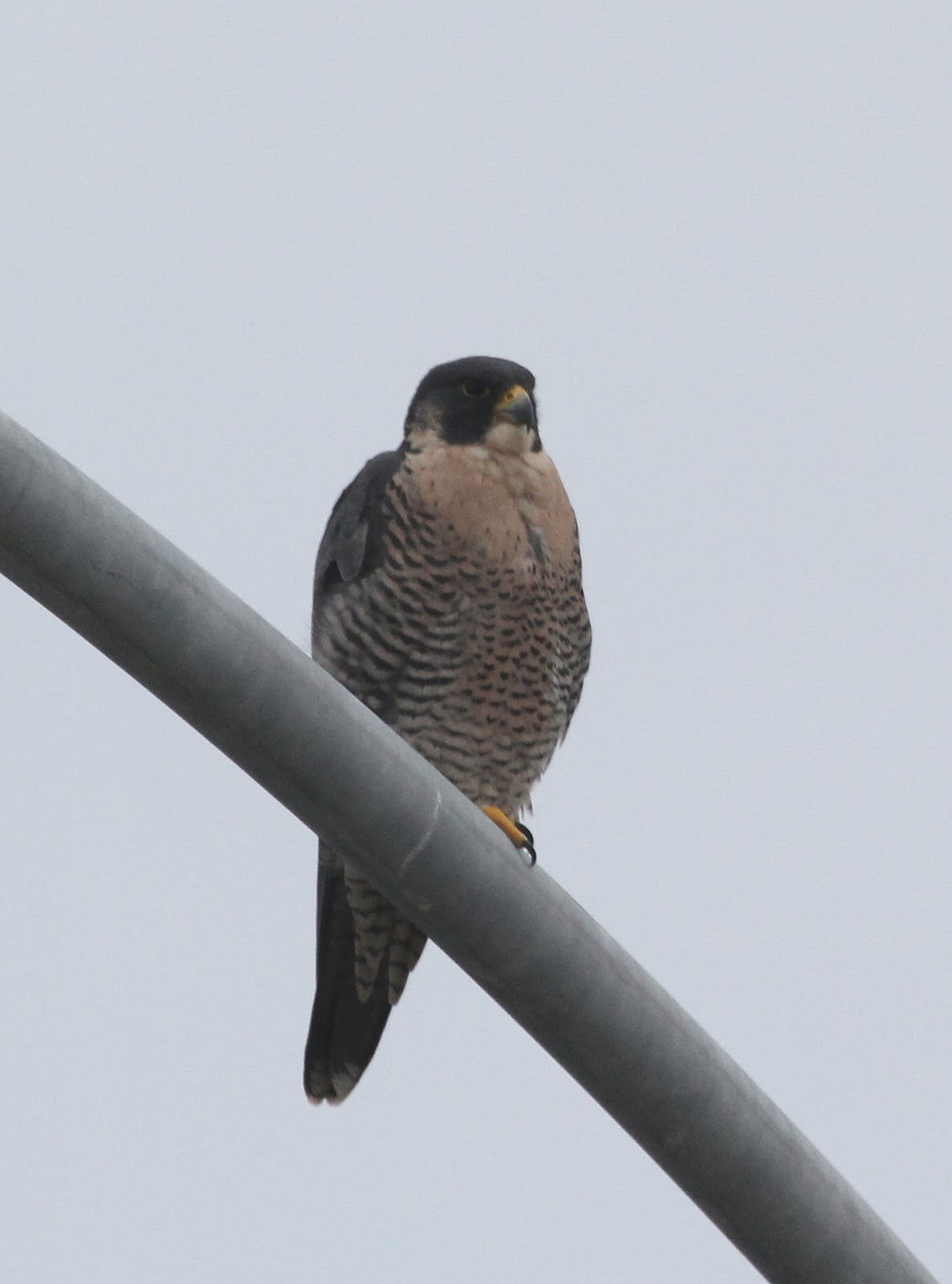
I went to the Eastern Shore on a dark day in November with a friend, hoping for some vagrant birds. We had no luck with rarities, but on the return trip, I spotted a Peregrine Falcon perched on a light post. After slamming on my brakes and backing up down the highway, I got some photos, but they were all dark and muddy looking because of the weather. I've never had photo-editing software other than the basic tools that come free with the camera (I've always been unreasonably stubborn about not using “tricks” or "cheating"  to get a better photo than what I took). But my friend took one of the photos and did some work on it with PhotoShop, and when he sent me the result, it blew me away! I immediately decided that I must trash all my principles, buy Lightroom, and start learning how to use it to improve my photos. Here are the before and after results of the Peregrine:


As I do every summer, I did raise and release some butterflies in my yard from caterpillars that I search for and find on the native plants in my garden. I've talk about this before; I collect the caterpillars and house them in screen cages in my garage, where I feed them at least twice a day. After a couple of weeks of doing nothing but eating and pooping, the caterpillar morphs into its chrysalis stage and remains dormant until it emerges as an adult butterfly. This process requires tending to the caterpillars at least twice a day, and is actually a main cause of my not being able to go out on field trips; if you’re not there to clean the cages and feed the caterpillars on time, they will not survive.

Over the past few years I have raised and released over 6000 butterflies of over 20 different species, which is very rewarding. The survival rate of caterpillars in the wild is extremely low, so raising and releasing results in a few more butterflies out there in the neighborhood and the world. This year I was thrilled to raise and release two new species that had never laid eggs in my yard before, the Viceroy butterfly and the Giant Swallowtail.

Freshly-hatched Viceroy butterfly. That's its chrysalis on the right, from which it just emerged.

First the Viceroy: Different butterfly species are dedicated to specific kinds of plants (called “host plants”) when it comes to laying their eggs; they only lay them on the foodplants that the hatched caterpillars will eat.  I had never planted the Viceroy’s host plant before; I had seen a few adults nectaring at my flowering trees and shrubs, but had never found caterpillars until I found them this year on my new Corkscrew Willow. My father died a couple of years ago, and as a memento, I took some of the Corkscrew Willow cuttings from the flower arrangements at his funeral, wrapped them in wet tissue and flew home with them in my suitcase. Once I got home I put them back in water until they rooted, then I planted them in dirt. This year they were large enough to put outdoors in big pots, and they grew into trees that are 6-8 feet tall now. Corkscrew Willows are one of the Viceroy’s host plants, and one or two adults found them and laid their eggs.  Success! (If you plant it, they will come….)


The other new butterfly species to lay eggs in my yard this year was the Giant Swallowtail (above). This is a southern species that is common in Florida but is decidedly uncommon in Virginia; they do not even occur here most years. One day I noticed a bunch of tiny, newly-hatched caterpillars on a small little Rue plant that I had in a pot. I presumed they were common Black Swallowtail caterpillars, which eat Rue, and I checked them every day or so to see whether they were running out of food and needed to be moved to my Parsley or Fennel plants, which they also eat. I finally noticed that they looked “different,” and realized that these were, unbelievably, about 60 Giant Swallowtail caterpillars! Giants also eat Rue, but not Parsley and Fennel, so I was out of food for them. I called my butterfly friends immediately, and they saved the day when they brought me a potted Citrus tree; in Florida, citrus trees are the most common Giant Swallowtail host plant. I gave away most of the caterpillars, but kept about a dozen that fed on the citrus tree and then went into chrysalis. Most later emerged as adult butterflies, like the one above.

 Young Giant Swallowtail caterpillar. They look like bird poop to predators, 
which is a very effective defense mechanism.

Here he is, several days older. He has lost his slick sheen, but
still looks rather distasteful!

 If bothered, these caterpillars attempt to scare away whatever is bothering them 
by displaying their red osmeterium, or "horns."


 Unlike our other black swallowtail species, the 
Giant Swallowtail's underwings and body are yellow.


Some of the Giants went to Lauren Tafoya, who manages the butterfly house at the Norfolk Botanical Gardens. She does an amazing job there, raising and releasing thousands of butterflies of many species each year. She had a few Giants at the Gardens already, but the ones she added from my yard will expand their genetic base and obviously increase the population. If you go to the Botanical Gardens next spring, you might see some of the grandchildren and great-grandchildren of the butterfly that laid eggs on the little Rue plant in my little yard.

Monday, June 3, 2013

Mercurial May

What a strange month May was this year! It seems that every time I had a day off work to go out nature-watching, it was either rainy, cold, windy, or dark and gloomy; none are good conditions for bird photography, and of course butterflies and dragonflies were scarce, if flying at all. Nonetheless, I was able to  visit a few places and take a few photos to share with you.


To start out the month, my aunt from California flew in to Richmond for a couple of Roads Scholars trips (previously named Elderhostel), and I spent the weekend and my birthday with her in Richmond. On Saturday we went to Maymont Park (photo above), but spring had not yet arrived there; it was cold and cloudy. It's a gorgeous park, though, and I intend to go there sometime in the summer; it has lots of possibilities for butterflies and dragonflies.

On Sunday we went on a pontoon boat Bald Eagle tour up the James River with Captain Mike, owner of "Discover the James" (http://www.discoverthejames.com). I highly recommend his trips; his pontoon boat seats six participants and he drives it about seven miles along the James pointing out the wildlife along the way. The focus of our trip was Bald Eagles, and they did not disappoint; we saw about 7 or 8 of them. Mike knows them all and their territories, as he has studied them for years, and knows where to find them. Unfortunately for me, it was another dark and dreary day, and the eagle photos I took are a bit dark and blurred -- but I'll share one anyway. The first photo below is of one of the Bald Eagles in flight clutching a fish, and the second is a Great Blue Heron that has just grabbed a fish that Captain Mike threw its way.


On the home front in Chesapeake, breeding season is in full swing. I have a bird house in my front yard that was investigated early in the month by Chickadees and even Eastern Bluebirds, but in the end a pair of House Wrens won the battle for it, and have built their nest inside; I should hear the babies soon.

Eastern Bluebird male investigating the bird house


One of the House Wrens that won the battle for the bird house.

An interesting fact about House Wrens: the males arrive on their breeding territories earlier than the females, and spend their time building multiple nests to impress the females. When the female arrives, she will hop from nest to nest to nest, and finally pick the one that strikes her fancy. Or desert to the neighboring male if she likes his nests better.

Last fall I posted photos in this blog of some impressive moth caterpillars that friends and neighbors brought to me. I put the caterpillars in my screen cages, and fed them until they went into their cocoon or pupae stages. They overwintered in that stage on my front porch, and two weeks ago one of them, the Polyphemus Moth, emerged! Below is the photo I took last fall of the caterpillar, followed by the moth:


I didn't even realize that the moth had emerged until I noticed two other Polyphemus Moths that were perched on my house near the cages. I then realized that "my" moth had emerged, and she was a female! Females send out their scent, or pheromones, and males can detect that scent from several miles away; the two moths on my house were males that came looking for my female. Here's a picture of one of the males; one of the ways to tell the male and females apart is to look at their antenna. The male's are much "fatter" than the female's (You can click on my photos to get an enlarged version for closer viewing):


By the next day I had five males, so I put them all in the cage with the female, hoping they would breed, which they did:


I should have kept the female in the cage with the leaves of her host plant (Oak), so she could lay her eggs and I could raise more caterpillars; this is what most other butterfly and moth enthusiasts would have done. But the adult Polyphemus Moth, like most of the other large Silk Moth species, lives for only seven days, and I just didn't want her to die in my cage. So I left the cage door open one night and all the moths left to complete their life cycles in the wild.

This is also the time of year that Luna Moths, another of the Silk Moths, emerge from their overwintering cocoons. Below is one that we found on the library's outside brick wall. Like the Polyphemus Moth, Lunas emerge, breed, lay eggs, and die within a 7-day span. They do not eat or drink in the adult stage; their sole purpose is to reproduce.


On a warm day in mid-May, I took a short walk along the Dismal Swamp Canal Trail in Chesapeake. If you haven't been there, you should go check it out. An 8.5-mile multi-use trail runs along the Dismal Swamp Canal, paralleling the old Route 17 to the North Carolina border. It is used by nature lovers, runners, bicyclists, and all manner of outdoor enthusiasts. (Check out the website at  www.cityofchesapeake.net/DSCT). I generally prefer to bird on the less populated west side of the Dismal Swamp, accessed in several places from Suffolk, but the Canal Trail is a nice, quick, easy place to access some of the Swamp's unique habitat if I don't have a lot of time to travel over to Suffolk.

Since the weather was warm, a few butterflies were active, and even though none were unusual species, I enjoyed photographing some "old friends." Here are a few favorites:

 Red-spotted Purple Butterfly
A lot of our swallowtail species also have black-with-blue coloration, but note that the 
Red-spotted Purple does not have the "tails" that the Swallowtails do.

 Zebra Swallowtail

 Tiger Swallowtails mineraling 

Spicebush Swallowtail

Blue-Gray Gnatcatcher


I threw in the photo of the Gnatcatcher because I've been trying, unsuccessfully, to get a decent photo of one, and I finally did. These tiny little birds are almost everywhere in the spring and summer months, and you've undoubtedly heard them even if you didn't know it; they have a soft wheezy, nasally, rambling song. These little guys are very active, like Kinglets, and are usually flitting about high up in a tree. They are also very curious; if you make "pishing" sounds, they will usually come in closer to investigate you, which is what the one in my photo did.

So, here comes summer now, and I hope that the excessive rains we had in May finally cease! If they do, I'll be out looking for birds and insects to photograph at Mackay Island, Piney Grove, Back Bay, Maymont Park, and hopefully some places in the Piedmont and in the Blue Ridge; the more different kinds of habitat you visit, the more possible species there are to find. I'll let you know what I saw next time, and if you want to share your own sitings with me, please feel free to comment. Or better yet, bring your photos to my next "Nature Photo Night" at the Chesapeake Central Library, which will be on Monday, July 29 at 6:00 p.m. Call me at 410-7147 if you would like more information about this -- ask for Karen.