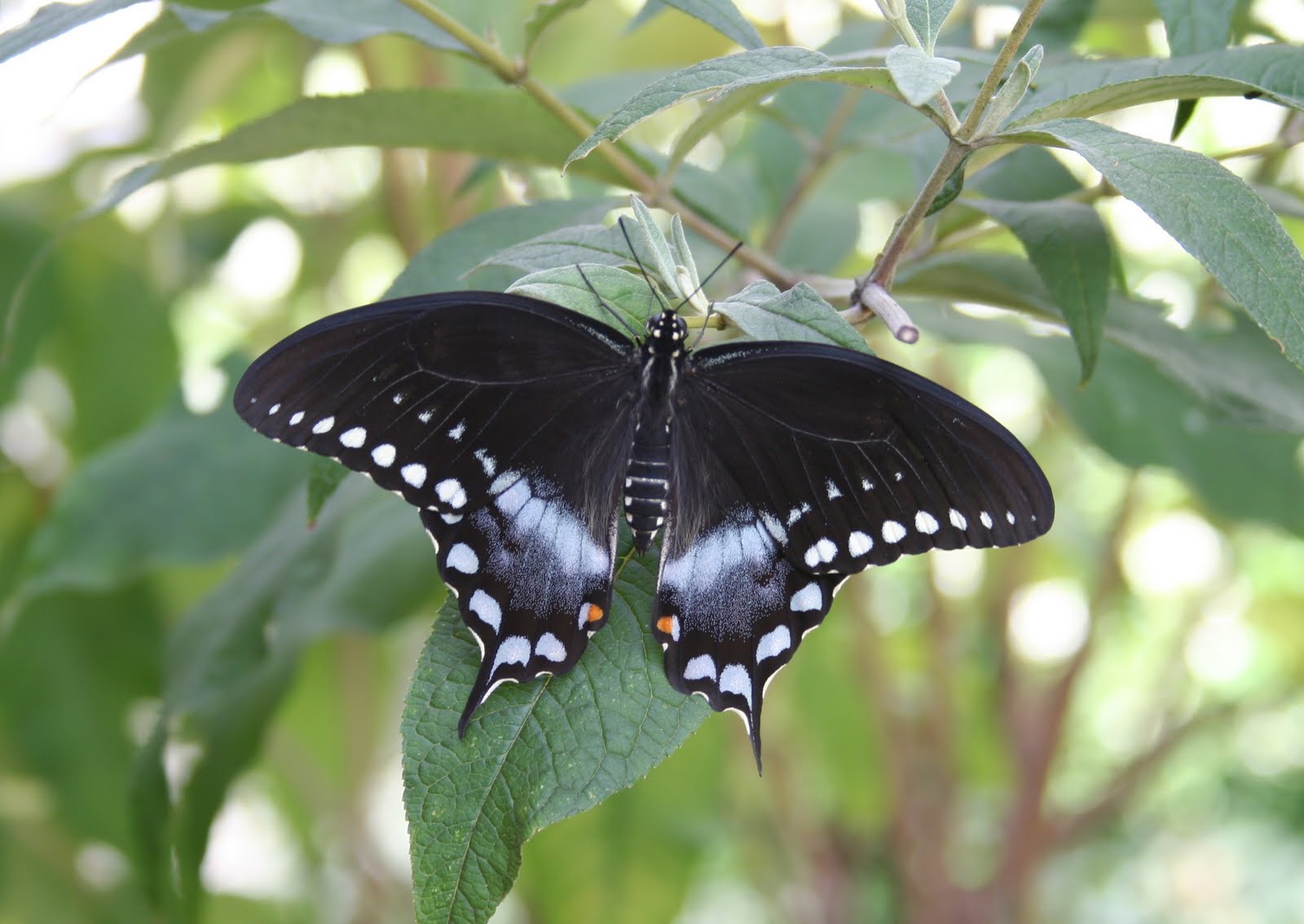
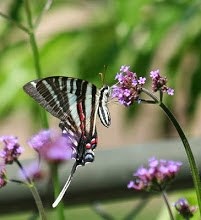
Sunday, October 17, 2010

IT’S OCTOBER: SHOULD I TAKE DOWN MY HUMMINGBIRD FEEDER?

Every autumn people tell me they’re taking down their hummingbird feeders for the season. It’s an old wives tale that if you leave your feeders up, the birds will not migrate. This is simply not true; no matter what, a healthy bird will follow its intense and primal instinct to migrate, and a birdfeeder will not delay that process. (Above: Female Ruby-throated Hummingbird in my Chesapeake yard)

But there is good reason to keep your hummingbird feeders up through the fall and winter. Every year there are a very few humming birds that do winter in Virginia, and they actually need our feeders far more than the summer birds do. The winter birds will not find natural sources of nectar, so their only chance of survival is to find a fresh and unfrozen hummingbird feeder to help them through those tough months.

It’s true that winter hummingbirds are quite rare in Virginia, and I myself have never had the honor of hosting one. But every year, a lucky few who do keep their feeders full attract one of these beauties. Wintering hummingbirds fall into two categories: those that are common here in the summer months and those that do not normally occur here at all. The first category, of course, is the Ruby-throated Hummingbird, the only hummingbird that breeds in the eastern United States. This is the species you see at Virginia feeders and gardens from April to late-September when they migrate south. (Photo of male Ruby-throat, above, courtesy of http://www.wikipedia.com/).

I mourn the Ruby-throats’ disappearance every October, and miss their antics; it’s great entertainment in the early fall to watch the year’s hatchlings learning how to be grown-ups. Ruby-throats are highly territorial and feisty, and they teach their young to be the same way. They muster up all the machismo they can and “play war” with each other, defending the best perches and the best nectar sources, and showing off for the ladies. And then one day, they’re just gone from my yard.

Most Ruby-throats winter in Mexico, Central America, and on Caribbean islands. Those that go to Mexico fly non-stop for 18-20 hours across the Gulf of Mexico, an absolutely remarkable feat. But a few do remain each year in the Gulf states and the Outer Banks of North Carolina, and, very rarely, one might stay along the Virginia coast, like the one in the photo, left, that spent all of last winter at a Sandbridge feeder. As you can see, this individual looks nothing like the splendid adult male with the showy red throat; most of the hummingbirds we see in the winter are “immature” birds that have the duller, plain plumage of the females.


The second category of hummingbirds that we hope for in the winter are the rarities, the vagrants from the western U.S. that have migrated here by an accident of nature. Instead of migrating south through the western states, a few always get turned around and head east instead. With luck, some find a feeder to sustain them through the winter , and what could have been bad news for the bird becomes a bonanza for birdwatchers, especially those who like to keep a “count” of all the species they have seen, and give chase to the rare birds that show up in their region. If a homeowner is hosting a rare winter hummingbird and shares this information with the birding community, he can expect anywhere from a few dozen to a few hundred human visitors who want to see the bird and add it to their “bird list.”

The most common of the western hummingbirds that occasionally shows up in Virginia is the Rufous Hummingbird. It breeds west of the Rocky Mountains, and was the most common hummingbird where I lived in western Oregon. Just last week, a beautiful subadult male Rufous or Allen's Hummingbird (the two are difficult to distinguish until they are in full adult plumage) showed up at Mark Mullins' feeder in Claytor Lake (Pulaski County), and undoubtedly a few more will be reported over the next few months. Mark took some gorgeous pictures of his bird, and graciously gave me permission to post them here (Thank you, Mark). The photo above is a picture from http://www.wikipedia.com/ of an adult Rufous Hummingbird. The following two are of Mark's bird; notice the subadult bird's gorget feathers just barely starting to grow in. Be sure to click on Mark's picture to see a larger version.


In December 2008, I made a run to Lynchburg to see a Calliope Hummingbird that a homeowner was hosting at his feeder. The Calliope too is a bird that breeds only west of the Rockies (left is an old photo I took of a male when I lived in Oregon). The Calliope is our smallest hummingbird, a tiny 3 ¼” long, and this little guy took a wrong turn on his way to Mexico and wound up in, of all places, Lynchburg, where winters are freezing cold! The homeowners there took extreme measures to keep their feeder ready for that little hummer; they strung up some kind of warming light that they found at a feed store to prevent the sugar water from freezing during the day. Every night they took the feeder inside, and then got up early in the morning to hang it back up for their guest. That Calliope survived there for several months before it migrated back to wherever it belonged.
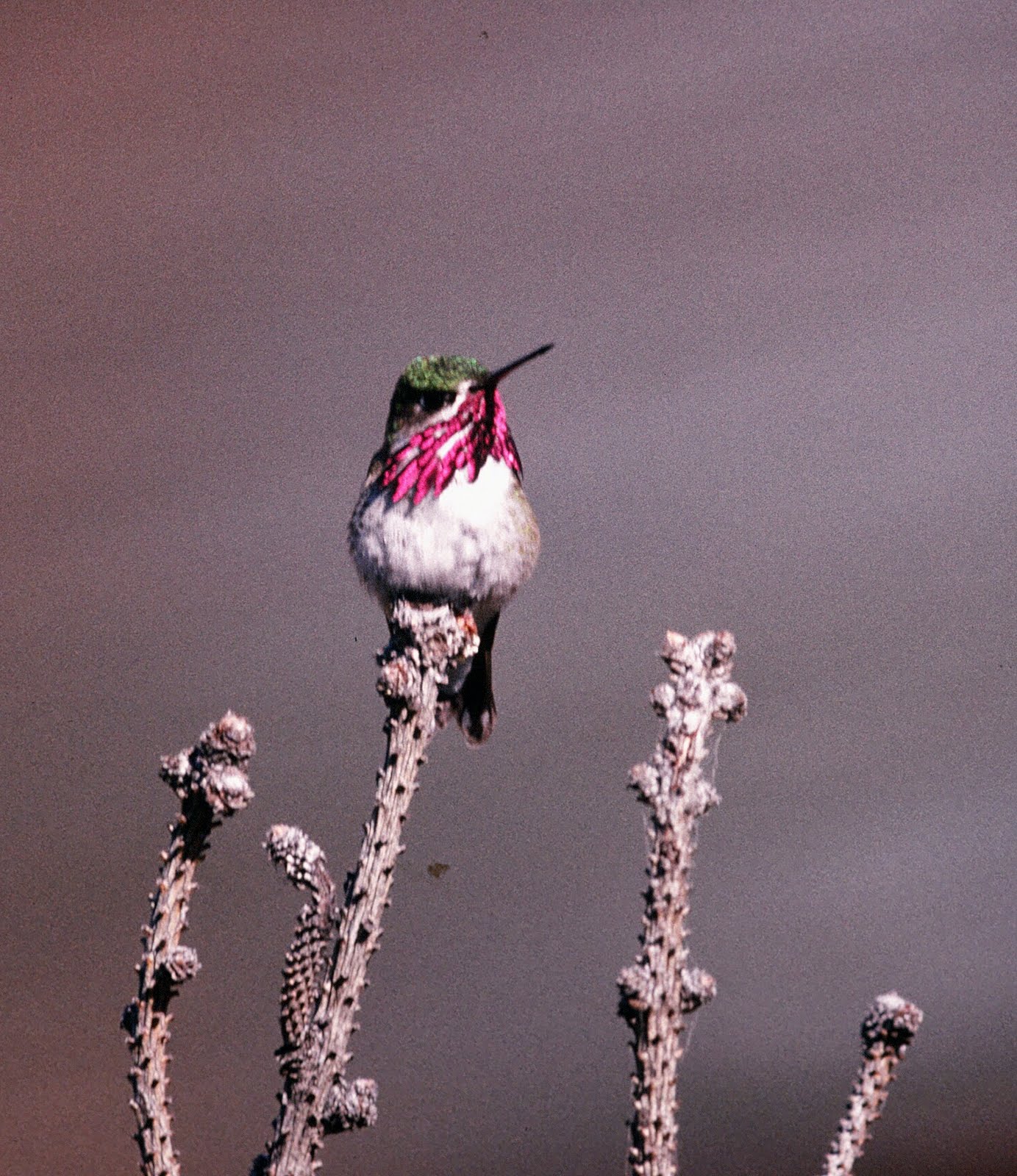
Here is my very poor picture of the Lynchburg Calliope. You can see that it is a female or an immature bird that lacks the distinctive plumage of the adult male above. The female and immature plumages of many hummingbird species are very similar, and it’s often difficult to make a positive identification by sight alone. Sometimes when a rare hummingbird is sited here, a hummingbird bander is called upon, especially if the bird might be a very rare species. He captures the bird by placing a sugar water feeder inside a cage and closing the door when the bird goes inside to drink; he examines the bird in hand, takes its measurements, checks on its health, and confirms its species before releasing it again.

Other rare hummingbirds that have visited Virginia feeders include Allen’s (photo of an immature California Allen's, left) and Black-chinned Hummingbirds. Again, your chances of seeing a winter hummingbird in your Chesapeake yard are slim at best, but they are absolutely zilch if you don’t put out a feeder. True, you have to replace the sugar water every day during freezing temperatures, but for me that’s a small price to pay if you save a lost bird. Now, about hummingbird feeders:

For some reason stores still sell a product they call “hummingbird nectar” that makes a red liquid when mixed with water. It was established years ago that adding a red dye to the water can only harm the birds, and is completely unnecessary. All they need is sugar water: put ¼ cup of sugar in a measuring cup then fill cup with water to the 1-cup line. Then stir well a few times until the sugar dissolves completely. You don’t need anything else. The hummingbirds do not need red water to find your feeder; the red parts of your feeder are completely adequate in getting their attention.

Maybe if all of us keep a feeder out for a few more weeks or months, one of us will be lucky enough to attract a hummingbird! Let’s try – and if you do see one, please call me right away at the Chesapeake Library (Karen @ 410-7147) and I’ll come out and take a look. (And you can decide if you want to share your bird with others; I won't spread the word without your consent). Good luck!

Wednesday, September 22, 2010

Fall Birding at the Eastern Shore

When I graduated from library school and was deciding upon places to apply for work, I chose Chesapeake as a possibility even though I had never been here. But I did know of some of the excellent natural areas nearby, and for me that was a big draw in choosing my future home. The Dismal Swamp, the Eastern Shore and especially the Chesapeake Bay Bridge-Tunnel, the 17-mile engineering wonder which connects Virginia Beach to the Eastern Shore of Virginia, are nationally known “hotspots” among people in the birding community, and I knew of these places even when I lived on the left coast. When I did move here, I started taking birding trips to the Bay Bridge-Tunnel and the Eastern Shore at least once a week. (Photos of Chesapeake Bay Bridge-Tunnel, left and below: courtesy http://www.cbbt.com/)

The Bay Bridge-Tunnel, a hotspot? Absolutely! During bird migrations, many birds land on its four “islands” to rest as they cross the water, especially if the weather is rough. (The islands are the manmade areas at each of the points where the road descends from the bridge down into the tunnels). And during the winter, these islands are an outstanding spot from which to scope wintering ducks and seabirds that are difficult to find from land. I’ve heard that over 400 different species of birds have been seen from these islands, including many impressive rarities.

For years, anyone who wanted to bird from the three northernmost islands would write to the Bay Bridge Authority and request authorization to do so for the coming calendar year (the southernmost island has a gift shop and restaurant, and anyone can stop there anytime). Each time we wanted to bird, we would show our letter of permission, vehicle registration, and driver’s license at the check-in station, and be able to bird to our heart’s content; I loved birding there. Unfortunately, everything changed after the September 11 terrorist attacks. The Bay Bridge Authority withdrew permission for anyone to stop on the three northern islands unless they are accompanied by a security guard that costs $50 an hour. For me, that’s prohibitive, so I’m not able to bird at one of my favorite places anymore. It’s a real sore spot among birders, because any yahoo with a boat and a cooler of beer can pull his boat up to the islands to fish, with no restrictions. But that’s another story…
Harlequin Duck at Bay Bridge-Tunnel


On to the Eastern Shore-- The southern tip of Delmarva is renowned as a major concentration point for migrants. Think about it: Delmarva tapers from a wide body of land further north in Delaware and Maryland down to its end at Wise Point, where the Bridge-Tunnel terminates. Birds that are migrating south down the peninsula reach Wise Point and are reluctant to cross the Chesapeake Bay, especially in rough weather or when a front is coming through, so they stall until conditions improve. There is actually a bit of a reverse migration when the birds stall; many reach the water in the morning (songbirds migrate mostly at night), turn around, and circle back north a few miles to land and seek refuge for the day. That’s when every birder who has a beating heart wants to be at the Eastern Shore, to witness these “fallouts” of migratory birds. The best-known places to search are the Eastern Shore of Virginia National Wildlife Refuge, Sunset Beach, and especially Kiptopeke State Park, all within five miles of Wise Point. Early morning is the best time, by far.

The Coastal Virginia Wildlife Observatory (http://www.cvwo.org) maintains a songbird banding station, a hawk banding station and a hawkwatch research station at Kiptopeke. Anyone can visit these stations during the August-November bird migration period; their volunteers and staff provide free daily public education about the birds they band, and it’s fascinating to watch them at work. They set up special mist nets in strategic places (these are like very fine volleyball nets), and capture birds that fly into the nets without doing any injury to the birds. Every fifteen minutes or so, staff retrieve the birds from the nets, and take them to the banding station, where they weigh, measure, and band the birds before releasing them again into the wild. The whole process takes only a few minutes. The scientific data they gather is critical to our understanding of the health of our bird populations. For people who don’t often observe birds in the wild, this is also a wonderful way to learn about and see different bird species up close and personal. My friend Nancie and I visited them last September, and she took all the pictures that follow:


Top left: Warbler in a mist net / Top right: Blowing the belly feathers to check the bird's fat reserves / Second row left: Weighing the bird / Second row right: Checking the bird's condition and health / Third row left: Black-throated Blue Warbler being banded / Third row right: Ovenbird / Bottom left: Yellow-breasted Chat with something to say / Bottom right: Gray Catbird being measured.

Kiptopeke is also the home of a famous hawkwatch, where experts come every day in the fall to count migrating raptors, including hawks, falcons, eagles and osprey (photo, above, courtesy of www.cvwo.org). The peak of hawk migration is probably late-September to mid-October but extends well into November. Kiptopeke regularly posts the largest bird numbers of any hawkwatch station in the entire country! Again, this is owed largely to the physical geography of the Delmarva Peninsula, which funnels the migrating birds and concentrates them in a small area at the peninsula’s tip, where the hawkwatchers and hawk counters await. These experts are amazing, and so skilled; they can identify a raptor that’s half a mile in the air by its wings shape and flight pattern alone. You can learn so much by spending a little time listening to these guys.

(Above : Merlin at the Eastern Shore: see the band on its leg?)

The best time to witness the bird migration on the Eastern Shore is now. To be sure, there are many days even in September when there is little bird activity, but there are also days that are a nature watcher’s dream, and the trees and skies are filled with birds. Everything depends on the weather. If the weather is warm, sunny and stagnant, the birds are less likely to stop and they fly right over the Eastern Shore. If there is some turbulence or a cold front, chances are you’ll see some good birds. Try taking a trip to Kiptopeke at 7:00 a.m. sometime this month, and let me know what happens!

Friday, August 20, 2010

WHAT’S THAT AT MY BIRDFEEDER? (Part I)

I remember the day I became a birdwatcher, back in the early 80’s. I lived in Oregon and I was an outdoors-kind-of-girl already, so when my future ex-husband and I planned our first vacation together we made it all about nature. We drove down the Oregon coast, into the California Redwoods, King’s Canyon, Yosemite National Park, and eventually made our way over to Arizona and the Grand Canyon. We bought three Audubon field guides for the trip: one about trees, one about wildflowers, and one about birds. We knew nothing about any of the three.

It was November, so walking the trails at Yosemite was not only incredibly beautiful, but the swarms of tourists were gone and we had the place to ourselves. The cold, clean air smelled of autumn, and the trees had lost most, but not all, of their yellow and red leaves. It was absolutely magical. I can still see in my mind’s eye the trail we were on when we looked over at a small puddle and noticed a beautiful blue crested bird taking a bath; in size it was somewhere between a robin and a crow. It was the first time I really took a moment to see a bird, admire its vivid colors and look it in the eye, and I couldn’t wait to see if I could find a picture of it in our field guide and put a name to it. I was thrilled when I was able to identify it as a Stellar’s Jay (photo above); to this day I have a special place in my heart for that species because it was my first real birdwatching bird.

My interest in birdwatching blossomed from that point, and soon we started putting birdfeeders up in our Portland yard. We quickly attracted a wide variety of seed-eating birds -- Black-capped Chickadees, Scrub Jays, Black-headed and Evening Grosbeaks, Golden-crowned Sparrows, Spotted Towhees and Band-tailed Pigeons to name a few. Rufous Hummingbirds came to the sugar water.

What do all those birds have in common? You will not see any of them here in southeastern Virginia. Most bird species have restricted ranges where they occur; something that is common in one state might not be found at all in its neighboring state. What is common in the western half of the country might not occur east of the Rocky Mountains, and vice versa. Some species like Mourning Doves, Downy Woodpeckers, Great Horned Owls and American Goldfinches do occur throughout North America, but most birds do not; their ranges are more limited.

So when I reluctantly moved with that future ex-husband from Oregon to Alabama, my silver lining was that I would get to explore new regions and see new and different species of birds. What I found in many cases was that the western species that were familiar to me had eastern “cousins” or counterparts; the “cousins” belong to the same family of birds but have evolved into different and distinct species, shaped by different environments, climates, food supplies,


Western Tanager (left) and Summer Tanager (right)

and a host of other factors. For example, the Western Tanager makes its home in the western states, but here in the southeast you’ll find the Summer Tanager instead. In eastern Virginia we have the Carolina Chickadee (below, right), but to the west of us you’ll find the Black-capped Chickadee (below, left). Same bird family and very similar in appearance, but genetically they are different species.


Someone suggested that I make a list of some of the most common birds that come to my Chesapeake birdfeeders, and share that with you all. Of course different species come at different seasons; the birds are entirely different in the winter than they are in the summer, and during spring and fall migrations there are always some surprises and a few rarities moving through. That being said, here are five birds that you’re likely to see in your Chesapeake yard; I will share more in my next blog entries:

The Northern Cardinal is a permanent resident here; you will see it all twelve months of the year as it does not migrate. While it is one of the most common and best known birds in the eastern states, it does not occur at all west of Colorado. The male is vivid red with a black mask; the female is a much more muted shade of orangish-red. Both sport a distinctive crest on their heads. During the day there is always at least one Cardinal in my yard, and right now, at least a dozen Cardinals congregate at my feeders every night at twilight to grab that last meal; they’re always the last bird to leave my yard at the end of the day.

The male American Goldfinch’s yellow plumage is just as vivid and striking as the Cardinal’s red plumage. If you happen to see these two birds next to each other on a sunny summer day, you can’t help but be awed that these colors are possible in nature. The Goldfinch is a very familiar bird in our area, and if you hang a thistle seed feeder, it won’t be long before these guys find you. As summer wanes and your flowers start going to seed, you will see Goldfinches on the seedheads extracting a meal; they are especially fond of zinnias and coneflowers. As with the Cardinals, the female Goldfinch is less brightly colored than the male, and she lacks the black “cap” that is so prominent on the male. Goldfinches do lose their bright colors in the winter, and fade to a pale version of themselves, but it’s fun to watch them in the spring as their breeding plumage returns a few feathers at a time-- they look like a patchwork quilt!


Winter Goldfinch (left); Summer Goldfinch on right (photo by Nancie Laing)

The Northern Mockingbird is another very common bird in our region. When I lived in Oregon, one or two would turn up as vagrants every year, but for the most part Mockingbirds are a more eastern bird. Almost every Virginian with a yard has a Mockingbird that has taken up residence nearby. They do not eat seeds or visit your seed feeders, but I feed mine apples (partially peeled) and a peanut butter concoction that I make (recipe is at the end of this posting). Mockingbirds are the champion “mimic” birds; they make more different kinds of sounds than almost any other bird, and they do mimic other birds’ calls. In the right season they will sing all 24 hours of the day, right through the night and usually right outside your bedroom window. Males and females have identical plumages. It’s easy to recognize one in flight by the prominent white edges on its long tail, and the white patches in the wings. (Photo of Mockingbird by Nancie Laing)


Everyone knows the distinctive Blue Jay when they see one. It is the only species of Jay that we have here in Virginia. They are rare in the western states when they occur at all; there they are replaced by other species of jays, including the Stellar’s Jay that I mentioned at the beginning of this posting, the Scrub Jay, and the Gray Jay in the mountains. Blue Jays are year round residents that do not migrate, and males and females look the same. If you suddenly hear a group of jays calling and getting excited, you will know that there is a predator nearby, usually a hawk or an owl, and that the jays are “mobbing” and trying to chase it away. They are the watchdogs of the birding world.

Five different species of woodpeckers have graced my yard. The one I see most frequently is probably the Red-bellied Woodpecker (An odd choice of name, as a red belly is certainly not its most prominent feature). They love suet and the peanut butter concoction that I make, and they also take sunflower seeds. Like other woodpecker species, they will “stash” food for an emergency winter food supply. I watched one summer as they tirelessly took peanuts from my feeder, flew across the street to the neighbor’s house, and stashed them – hundreds of them -- under the shingles at the peak of their roof. I do hope the neighbor never had occasion to discover this bounty…

More about the birds next time. In the meantime, let me share my peanut butter recipe with you. The birds love it, so be warned that if you start offering this treat to them they will devour as much as you can put out, especially during breeding season when they’re feeding their young, and during the winter when they need extra energy. It’s simple:

Combine 4 cups cornmeal, and 1 cup each of white flour, Crisco
vegetable shortening, and chunky peanut butter. Knead it
with your hands until it’s well-mixed and a little sticky.

I make “plugs” of this mixture, which I press into the holes of the log feeder you see in the picture of the woodpecker, above. The feeder is a 14” section of a red cedar branch; one-inch holes have been drilled into it for the plugs, and an eyebolt has been screwed into one end so the feeder can be hung from a hook. If you don’t have a feeder like this, you can buy one on eBay as I have, make one yourself, or you can put the peanut butter mixture out in some other fashion, for example pressing it into pine cones and hanging the pine cones in a tree.

You can find a lot of ideas about how to attract birds to your yard and feed them by browsing the library’s books in the non-fiction section; try the books with Dewey numbers of 639.978, and the general bird books in the 598 area.

Saturday, July 10, 2010

A CHESAPEAKE BUTTERFLY GARDEN

I love taking little trips to different parts of Virginia to find different species of wildlife. But in Chesapeake you really don’t even need to leave home to find interesting things. I have lived in a pretty typical suburban neighborhood in Chesapeake for almost eight years, and during that time I’ve seen 96 different species of birds in my yard, and 53 different species of butterflies, including this Tiger Swallowtail (Virginia's state insect). Not bad!

I also “raise and release” different kinds of butterflies right in my yard; this has become a popular past-time among many butterfly enthusiasts. Since 2005, I have raised and released a total of 2954 butterflies of 19 different species; I counted the totals today just for this blog. (Hey, I’m a librarian and I keep records of everything!) I raise these butterflies from caterpillars I find on the plants in my yard. I collect the caterpillars, place them in a screen cage, and feed them until they go into their chrysalis stage. After a couple of weeks in chrysalis, a new butterfly emerges.

To illustrate, here are some photos of the different stages of a Question Mark butterfly I raised; on the left, the caterpillars I found on my hops vine; on the right, the chrysalis, and in the center, the adult butterfly:


It’s not just by chance that the different kinds of caterpillars I collect find their way to my yard; I started the process by planting the appropriate native plants that attract the butterflies that lay the eggs. Each different species of butterfly lays its eggs only on a certain type of plant (called the “host plant”), because the caterpillars that hatch from the eggs can only survive by eating that particular plant. One of the host plants for the Question Mark butterfly is the hops vine, so I planted one for the purpose of attracting them to my yard.

The trick to getting butterflies in your garden, then, is two-fold: First, you want flowering “nectar” plants for adult butterflies to feed on, which most people know about (If you can only have only one flowering shrub in your yard, make it either a Butterfly Bush or Lantana; you will be amply rewarded with butterflies). Second, you want the butterfly’s’ host plants if you want them to lay eggs and produce caterpillars.

How do you know what the host plants are for different species? The two best sources I know are 1) a list of Tidewater butterflies and their host plants published on the Butterfly Society of Virginia’s website (http://www.butterflysocietyofva.org/ ; take the link to “Host Plants in VA"), and 2) a wonderful book by Doug Tallamy called “Bringing Nature Home: How Native Plants Sustain Wildlife In Our Gardens.” This highly readable and surprisingly entertaining book is full of information about the kinds of plants that attract different kinds of wildlife including butterflies. I highly recommend it.

A symbiotic relationship has evolved over countless millennium between wildlife and plant life, so it's not surprising to learn that most of the butterfly host plants are plants that are native to their particular region. If you plant a plant that comes to us from China, our adult butterflies might drink nectar from its flowers, but our caterpillars will not be able to survive on its foliage and the species will not reproduce.

In my garden I have a mix of flowering plant for nectar, and native host plants for the caterpillars; I’ve planted a Pawpaw tree which is the host plant for the Zebra Swallowtail, two Spicebushes for the Spicebush Swallowtail, milkweed for Monarchs, passion vine for fritillaries, fennel and rue for Black Swallowtails, Wild Cherry trees for Tiger Swallowtails and Red-spotted Purple butterflies, a Hackberry tree for American Snout, and many more. Most nurseries do not carry a wide variety of native plant stock, but you can purchase most of the plants you need at plant sales hosted by the local Master Gardeners organizations (http://www.vmga.net/), the Butterfly Society of Virginia (http://www.butterflysocietyofva.org/) , and the Virginia Native Plant Society (http://www.vnps.org/). I have also had success ordering native plants online through nurseries that specialize in natives.

Here are pictures of some of my "children," the caterpillars and the adults:


The Spicebush Swallowtail caterpillar you see here (above) uses "fright" as a defense. The "eyes" that you see are supposed to make the caterpillar look like a snake and scare away potential predators. The "eyes" are not eyes at all; they are clever pigmentation on the skin, including the white "sparkles" in the black "pupils." This strange-looking little thing turns into the gorgeous butterfly you see on the right.


The spectacular Zebra Swallowtail uses only leaves of the Pawpaw tree as its host plant. This is the first year I finally found some of its caterpillars (above) on my Pawpaw tree, and I'm thrilled to have raised and released ten of them so far.

The alien-looking creature below is the larva (caterpillar) of the Silver-spotted Skipper. Be sure to look at this one in an enlarged version (just click on the picture to do this), because it is a strange-looking little guy. These skippers eat Wisteria leaves -- but not the invasive, non-native Wisteria that you see everywhere in April and May. We have a Wisteria that is less aggressive, and is native to Virginia, and this is the type this skipper needs.


Below is an American Lady caterpillar on its host plant, Pearly Everlasting (it also uses Cudweed and Hollyhocks as a host plant). The adult (right) is a very common butterfly in Tidewater, but it has a rare beauty if you look closely.


The two caterpillars most commonly and easily raised by people in the Chesapeake area are Monarchs (host plant is Milkweed) and Eastern Black Swallowtails, which use plants in the carrot family as their host (these include fennel, parsley, Queen Anne’s Lace, dill, and rue). Of all the butterflies I’ve raised and released, almost 2000 of them have been of these two species. If you’re interested in learning how to raise and release butterflies, these are the species you should start with; plant some parsley or fennel and the Black Swallowtails (above) will find you. Just remember to plant enough to feed these little eating machines for a couple of weeks.

These are just a few of the gems from my garden. Some people wonder why one would bother to raise the caterpillars themselves rather than just let Mother Nature take her natural course. The benefit to the butterflies is that they have a far greater chance of surviving to adulthood; in the natural world most do not survive due to predation and parasites. Are we upsetting the global balance by releasing more butterflies than nature intended? I believe the answer is no; the numbers we release into the world are less than a drop in the ocean. But we do have a few more butterflies in our gardens than we did before, and we have the joy and satisfaction of witnessing nature's miracles first-hand.

If you are interested in trying your hand at this rewarding and fulfilling process, feel free to send your questions to me. I have a lot more information and suggestions that I can share with you that will help you get started and ensure the success of your butterfly-rearing.