Monday, July 9, 2012

June Nature Photo Night at the Central Library

Our second “Nature Photos at the Library” event on June 26 was a lot of fun, and, as we did the first time, we had a lot of talent in the room and an excellent diversity of photos. We all agreed that we are going to continue this event and get together four times a year to show the nature and wildlife that we have photographed during the previous season. All ages and skill levels are welcome to join us, whether to show their own photos or just to watch what other are showing. (Please, call me if you have any questions or would like more information about what we do! My number is 757-410-7147; ask for Karen).


Three of our photographers have shared their photos with me and have allowed me to post them here on my blog. A big thank you to Tim Fearington, Chris Williams, and Nora Leonard!
This was Tim’s first time with the group, and he definitely “wow-ed” us with his talent. I would venture to say that his photos were professional quality; the amazing picture of a Ruby-throated Hummingbird at the top of this blog post is one of his photos. He showed us an entire sequence of this little gem as it fed; as you can see, the bird’s entire bill disappeared into these tubular red flowers as it searched for nectar.
Tim is also fond of photographing our local populations of Bald Eagles. The outstanding photo below is one of many that he showed, and is the one he selected to post here:


Chris spent some time this spring at the Girl Scout Woods and at Bell’s Mill Park, both in the Great Bridge area of Chesapeake. The two photos below were taken at a nesting cavity he discovered that was occupied by Brown-headed Nuthatches. These are tiny little birds that are very active and noisy  in the tops of tall pine trees and can be hard to find at eye level --- and very hard to photograph, since they are usually in motion!
Brown-headed Nuthatch having a stare-down with Chris.


Both Nuthatch parents are trying to enter their nesting cavity at the same time!


Chris also found this Red-bellied Woodpecker and got a great “up close and personal”  photo of it. He got so close that you can see the bird’s feet; woodpeckers have two front claws and two back claws, which allows them to cling to the sides of trees.


Below is Chris’s photo of a Green Heron silhouetted against the sky and perched at the top of a dead snag:

Nora gave a great show, as she did the first time we all met. She shared the two photos below for this blog:
This male Common Grackle has a sunflower seed in his bill; great catch, Nora!

This one made everyone laugh! This giraffe at the zoo wanted to eat something down low 
very badly, and this was the only way he could lower himself.
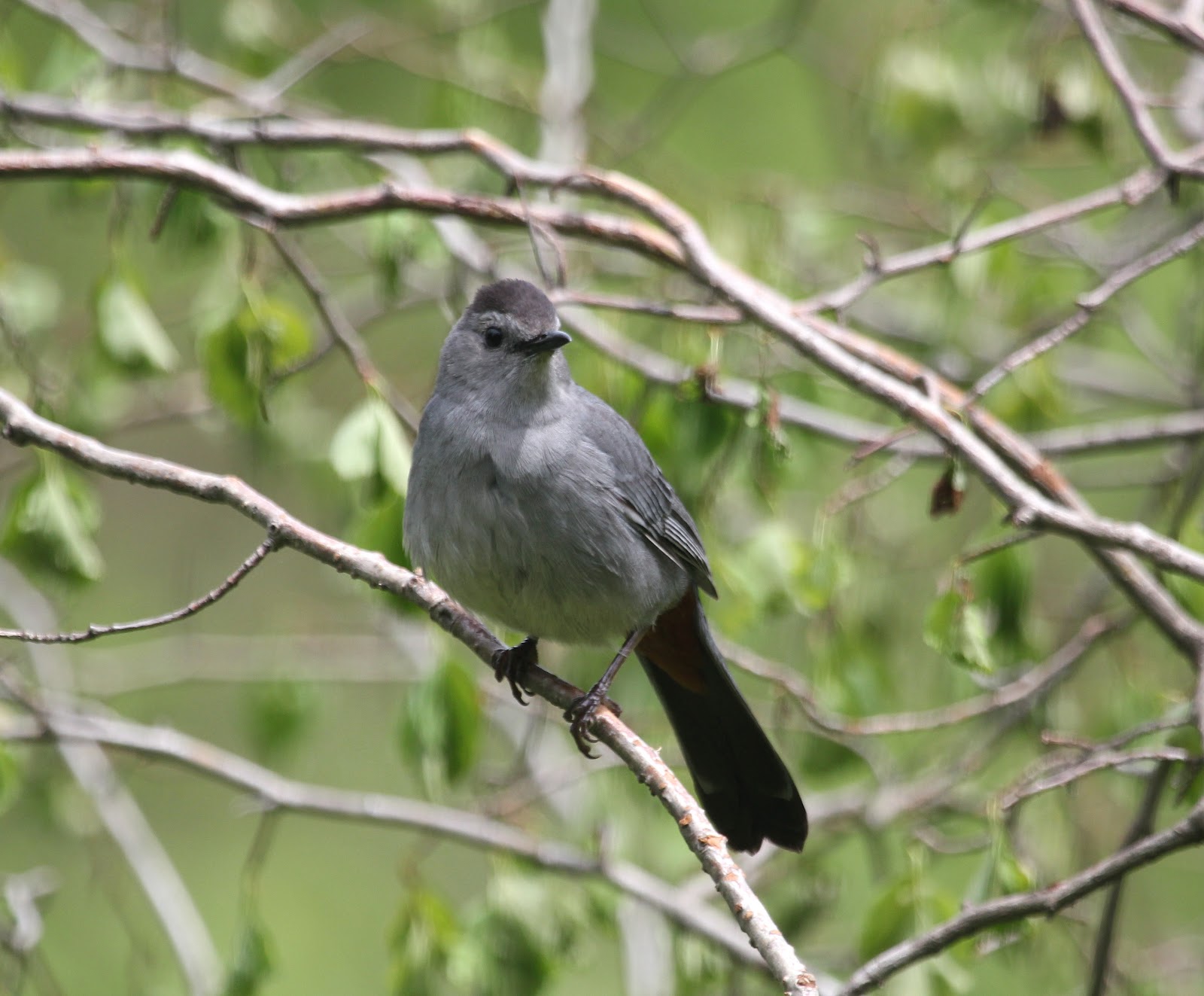
I showed a few bird and butterfly photos myself, including these three. The first two were taken at Pocosin Cabin along Skyline Drive in the Blue Ridge Mountains, and the third was taken at Piney Grove near Waverly:


Gray Catbird --(yes, it "meows" like a cat)!

Male Chestnut-sided Warbler, a common breeder in the Blue Ridge.

The Yellow-breasted Chat is our largest species of Warbler. "Chat" is a very appropriate name, as it vocalizes incessantly in the breeding season, making  a large variety of calls including whistles, cackles, mews, chuckles, rattles, squawks and gurgles!


We’ll end this post with two more photos that Tim shared. The first is a male “Blue Dasher,” a common species of dragonfly in our area. Tim took an ­uncommonly terrific photo of this individual, which allows you to see all of the beautiful and complex colors and patterns that you do not see with the naked eye.

I am so envious of this last photo of a male Belted Kingfisher! (Females have a fat rusty-orange stripe or "belt" across their breast). I have tried for years to get a good photo of this species, but these are very wary birds and seldom let you approach them closely. Most of my attempts are photos of a small, blurry, bluish bundle of feathers flying away from me. Tim did an outstanding job of capturing this individual on film (or should I say “memory card”).

Our next photo night will be on Monday, September 24 beginning at 6:00 p.m. I’d love to continue to see more new faces and more perspectives on our local nature and wildlife. It’s fun, and we all learn from each other, so please join us if you can!

Thursday, June 21, 2012

2nd "Nature Photos at the Library" Evening at the Library

In the blog I posted 2 or 3 months ago, I talked about the "Photo Night" event that we had here at the Central Library. Fifteen people came together to show or watch each others' nature photography and discuss our local nature and wildlife. We had such a good time that we decided to do it again at the end of spring.

So, our second meeting will be on Tuesday, June 26 at 6:30 p.m., again at the Central Library (298 Cedar Rd., Chesapeake). If you would like to show photos you have taken of nature or wildlife this spring, bring them in a digital format on a USB device or a CD. We will project them from our laptop computer onto the library's big screen.

If your photos were not taken this spring, that's okay too. All ages and all levels of proficiency are welcome to come. And if you don't want to show photos but would like to come watch what others show, please do!


If you have any questions or do want to show some photos, please give me a call or drop me an email. Ask for Karen at 410-7147, or email me at kkearney@infopeake.org. I hope to see you on the 26th!

Sunday, May 20, 2012

SPRING THINGS


In late April and early May I want to do as much nature watching as I can, within the constraints of work, my lawn needing to be mowed, and my cats needing to be petted. Migrating birds are returning or passing through our area now, and insects are waking up and become active on the warmer days, and I want to see as much of spring as I can. Unfortunately the weather has to cooperate on the days I have off, and that doesn’t always happen, so I haven’t been able to get out nearly as much as I’d like. But I have managed a few day trips in the past few weeks, and I’ll share some highlights with you.

The bird at the top of this page is a “Prairie Warbler,” a common breeding bird in southeastern Virginia that arrives here from its wintering grounds around mid-April. You will see and hear them in a variety of habitats as they establish their breeding territories, including pine woods and open fields. I photographed this individual in the Zuni Pine Barrens in early May.

I love to go to the Great Dismal Swamp in the spring, and walk along Jericho Ditch or Washington Ditch in the morning. On most days you will hear a veritable symphony of birds there, including warblers, vireos, flycatchers, woodpeckers and many others. The Prothonotary Warbler (photo below) is one of the signature birds of The Swamp, and is one of the most vocal. Because this beautiful bird only breeds in swampy and wet areas of the southeastern states, birders from other areas of the country target this bird and travel here to see them and add them to their “life lists.” The Dismal Swamp is well known as one of the best places to see them, and attracts these birders. I photographed this one there in late April.


Another common warbler of The Swamp and other environs is the Common Yellowthroat. The male Yellowthroat has a distinctive black “mask, visible in the photo below. This one was singing his little heart out and just demanded my attention! (Too bad he was in the shade…)


 On the same day that I photographed the warblers, I managed to get this photo (below) of a “Swamp Darner.” This is our largest dragonfly species, and they are plentiful and conspicuous at this time of year at the Dismal Swamp and other wet areas.  Also common this time of year is the “Harlequin Darner” (second photo below), one of the smaller members of the Darner family.


In early May I made a day trip to Chincoteague National Wildlife Refuge, which is at the north end of the eastern shore of Virginia. A trip there is always rewarding, and it is a very popular destination for birders, beach-goers, pony watchers, and all sorts of nature enthusiasts. One of my favorite things about going there is the view from the causeway that connects  Wallops Island to Chincoteague Island. The road is built in the middle of extensive marshes and wetlands, and in the spring you’ll see hundreds, if not  thousands of birds as you drive along. There are a few places where you can pull your car onto the shoulder of the road to get a better look, and that’s where I photographed the three birds below:

Common Tern
Black-necked Stilt (amazing long legs!)

Glossy Ibis

There are several areas to bird on the refuge itself, and a variety of habitats that each host different species of birds and wildlife. The result is that you can find a wide variety of birds in a relatively small area: songbirds in the woods, shorebirds on the mudflats, gulls, terns and waterfowl over the water, eagles and raptors in the skies, and herons and ibis just about everywhere. The water levels were very high the day I was there, which meant there were no flats or shallows for most of the birds I wanted to see, so I continued on down to the beach at Tom's Cove, parked, and walked a half mile or so down the beach in the sand. The highlight of the walk was this guy, who, surprisingly, started walking directly at me (the opposite of what birds usually do – they’re always going “away” from you!):


Suddenly, he stopped at an inconspicuous little scraping in the sand and sat down, which is very unusual for a shorebird:


 Then, after a minute or two, he stood up and I could see the reason for the bird’s odd behavior:


This American Oystercatcher had made its nest right there, not ten feet from the rope that separates the “people beach” from the closed off area protected for wildlife. There were three speckled eggs in the “nest” that he/she was incubating. It’s amazing to me that the bird chose this spot, and tolerated all the people nearby.

The next month will be very active, with breeding birds and increased numbers of butterflies and dragonflies. Try to get out there if you can! We're going to host another "Nature Photos at the Library" evening on Tuesday, June 26 (beginning at 6:30 p.m.), so see if you can get some photos and come share them with your fellow nature enthusiasts. Your photos can be of anything in nature that inspires your photographic talents. I'll have more on that in my next blog, but feel free to call me at 410-7147 (ask for Karen), or email me at kkearney@infopeake.org, if you would like more information.


Sunday, April 29, 2012

BUTTERFLY ACTIVITY THIS SPRING


Happy Spring to everyone! This is the time of year when everything is greening up and warming up (well, except for our recent cold spell. It’s another “weird weather” year). And every day that I can, I look for new spring arrivals wherever I am, and note the year’s “firsts” – the first spring Purple Martin; the first hummingbird, the first egg-laying butterflies, etc.  I’ve already seen all of the above and much more, and I hope you have noticed too.

Last July I wrote in my blog about some of the butterfly and moth caterpillars that I have raised and released. Do you remember this guy?


It is a Cecropia Moth caterpillar that I caged and fed until it went into its cocoon stage. The cocoon was very cool; the caterpillar spun a silk cocoon around itself and attached itself to the wall of the screen cage it was in. I left the cage on my front porch all fall and winter so the cocoon would mature naturally under  its normal timetable and normal temperatures (If you bring chrysalis or cocoons indoors into warmer temperatures, the butterfly or moth will probably emerge too early, before nature is providing its food sources, and while it is still too cold outdoors for its survival).

I expected my moth to emerge around June, but it made its grand entrance into the world on April 21, perhaps earlier than usual because of the warm temperatures we had in the early spring. Here’s the moth, perched on my hand:


Isn’t he (she?) magnificent! The Cecropia in the largest moth in North America, and as you can see, he was almost as big as my hand. And what a gorgeous pattern and vivid colors! Other moth species that I have raised have been very placid the day they emerged, not moving much, and easily handled. Not this one; he was feisty from the get go and not happy to have me admiring him. So right after I took my photo, I placed him in my Wild Cherry Tree, where he quickly maneuvered up the branches to a spot where he roosted for the rest of the day. What a thrill!

On the same day that our largest moth appeared, I found the tiniest of butterfly life on my Tulip Poplar tree. I was checking it for Tiger Swallowtail caterpillars because I had seen some adults in my yard the week before and guessed that they were laying eggs  (the Tulip Poplar is one of the Tiger Swallowtail's host plants). I chanced upon a caterpillar that had just barely hatched from its egg. I was not able to get a good photo with my camera equipment, but this photo does show you what it looked like:


The first thing a caterpillar does when it emerges from its egg is to eat the egg for instant nutrition. That’s what this guy is doing. Consider that this egg is substantially smaller than the head of a pin, and you’ll get some perspective on how tiny the caterpillar is. (He reminds me of the kid in that car commercial, wearing a Darth Vader costume and trying to perform some hocus pocus on the car). Here's what it will look like in about a month:


I’ve already seen Red Admirals laying eggs on my False Nettle, Palamedes Swallowtails laying eggs on my Red Bay, Black Swallowtails laying on my Fennel, Monarchs on my Milkweed, more Tiger Swallowtails on the Tulip Poplar and the Sweet Bay Magnolia, and American Ladies on my Pearly Everlasting. It should be a good year for raising butterflies, and I’ll keep you posted!

Wednesday, March 28, 2012

Nature Photo Night at the Library!

Fifteen people young and “older” came together at the Chesapeake Central Library the other night to show their nature photos, and wow! we had a good time! Some came to show photos and some came to watch, and everyone enjoyed themselves. (Photo, left, taken by Bill Niven)

The library has a meeting room with a ceiling projector that hooks up to our laptop, and projects onto a big movie screen, so anyone who brought their photos on a USB device or a CD was able to show their photos “super-sized.” Everyone discussed the subject of each other’s photos and we all learned a lot about local nature, wildlife, and where to go to experience it. And we also enjoyed starting new friendships with people who share the same interests. We will continue to have a photo-sharing night at the library on a regular basis – more on that later!

The people who shared their photos have kindly given me permission to post some of them here. I would love to show all of them but I can’t, so we’ll have to limit it to two (maybe three) photos per person – and it’s very hard to leave any out. Please enjoy the show! ---

This beautiful Tri-Colored Heron was photographed by Chris Williams. Chris has just started to photograph birds and nature, but he has been a birder for over a year. He also photographed the "Woody Woodpecker" below (the actual name is the Pileated Woodpecker). This bird is the largest woodpecker species in North America, and can be very difficult to photograph well. Great job, Chris!

Nora Leonard took this gorgeous close-up photo of a dragonfly (below), and managed to keep it in sharp focus. The colors are beautiful, and she used the depth-of-field features of her camera to blur the background, which emphasizes the subject of the photo. This dragonfly species is the Halloween Pennant, and is a female (The male has the same pattern but has a darker, reddish/orange coloration).

Nora also took the next photo, an amazing capture of a Black Bear along Skyline Drive in the Blue Ridge Mountains. She says that right after she took this photo, the bear scooted back down the tree and ran away, and she was amazed at how fast it moved!

Judy Ferguson came upon a field of Black-eyed Susans and captured this beautiful image:

You might know Judy and her husband as the owners of a "Virginia Grown" farm here in Chesapeake. In addition to being known for the honey, eggs, vegetables and more at their popular produce stand, they are known as the "Mule People." People constantly pull off the road by their farm to look at their mules and show them to their kids. Well, mules are "nature," and Judy brought this fun photo of one of her mules, "Virginia":

Our youngest photographer was Serena Bynum, who has just begun to take pictures but has a great "eye" for photography. She took a walk around her Chesapeake neighborhood, and found the beauty in things we pass by every day but might not notice. Serena noticed, and took the next two excellent photos:

Spring Tulip

Ivy in the Fog: I think this has a Medieval feel to it!

Bill Niven took the beautiful autumn photo at the beginning of this blog entry. You don't have to travel hours to go to the mountains to find these magnificent colors; he took the photo at Oak Grove Lake Park right here in Chesapeake last fall. The subjects of Bill's photography vary widely, and he showed a good diversity of photographs. Below is his magnificent close-up of an Iris, followed by a sunrise picture in Virginia Beach.


We really had some talent in the room at our program, so I can't resist adding just a few more photos here, even though I intended to limit them. I'll end on this note, and encourage you to just enjoy the nature that's right at your doorstep. We're going to have another photo night in June, so take some photos this spring and come share them with us!

Isn't this shot great?! Chris Williams caught this Brown Pelican at exactly the right moment, just after it had swallowed a meal.

Another photo from Judy Ferguson, taken at the Norfolk Botanical Gardens. I really like the composition of this one.

Nora Leonard captured these Royal Terns in flight at the beach. Beautiful!


And we'll end right where we began, with another beautiful autumn photo taken at Oak Grove Lake Park by Bill Niven.


Thursday, March 1, 2012

COME SHARE YOUR NATURE PHOTOS AT THE LIBRARY ON MARCH 26!

I have really enjoyed sharing some of my nature photos with you over the past two years, and I think that anyone who takes photographs likes to share them with others, discuss them, and get feedback. That gave me the idea to have an evening at the library for people to bring in their nature photos and share them with others who share their interest. (Common Buckeye, above)

My library has a meeting room with a ceiling projector that projects from our laptop computer to a big 12-foot screen. Anyone who wants to can bring in some of their photos on a USB device or a CD; we will show them and discuss them with the group. I think this will be a lot of fun, whether you are a seasoned wildlife photographer or someone who just took

a picture of your first Cardinal! And with the photographer’s permission, I will post some of the photos on this blog next month. (Green Tree Frog, above)

The program will be on Monday, March 26 starting at 6:30 p.m. at the Chesapeake Central Library (298 Cedar Road, Chesapeake). I would like to know how many people would like to come, and how much time to allocate time to each photographer, so I’m asking for advance registration. Simply call (757) 410-7147 with your name and contact information, and let us know how many people will be coming and how many will show photos. The week before the program, I will call everyone who wants to show photos and let them know how much time they will have.

Barred Owl, above

We will also have a door prize, a $15 gift certificate at Wild Birds Unlimited, our local nature store! They have two locations in this area, one in the Greenbrier area and one in the Hilltop area of Virginia Beach.

Baby Ratsnake, above

If you have any inkling that you’d like to show photos or just observe, please join us! If you have any questions at all, please call the library (757-410-7147), and ask for Karen (that’s me). I hope to see you there!

Friday, January 27, 2012

MONARCHS IN JANUARY???

Over the holidays I took a day trip across the Chesapeake Bay Bridge-Tunnel to bird the southern tip of Virginia’s eastern shore. It was unseasonably warm and sunny, as much of our winter has been this year, and as I walked around the trails of the wildlife refuge I stumbled upon several overwintering butterflies, including one big surprise, a Monarch butterfly!

As most of us know, the Monarch population of the entire Eastern United States migrates to Mexico every fall. Millions of adult Monarchs overwinter there in huge “clusters” or colonies in the higher elevations of Mexico’s mountains. We’ve all seen pictures of these colonies, with layers and layers of butterflies hanging from the trees (photo below courtesy of http://goodnature.nathab.com/). These butterflies don't begin their northward migration back to North America until around March.


I had no idea that any Monarchs actually overwintered in North America, so I did a little research. It is indeed a rare occurrence, but a few adult Monarchs, for unknown reasons, do spend the winter here, mostly on the Gulf Coast. “Journey North,” a web-based citizen science program, has collected data from reports submitted to them by people like you and me who observe wildlife, and they found that over a 9-year period between 2002 and 2009, 242 reports of overwintering Monarchs (January-February) were submitted. Of these, predictably, 80% of the Monarchs were seen in Florida and Texas. Only one report, submitted in 2006, came from as far north as Virginia. That report came from a Virginia Beach couple who documented a Monarch that wintered in their garden between September 5 and March 6 of that year. (If you’d like to read the entire published article about this study, go to http://www.hindawi.com/journals/psyche/2010/689301)

I was not the only person to see Monarchs on the Eastern Shore over the holidays. Another birder who lives in Cape Charles reported seeing “many” on one of the warm days we had. I reported our sitings to Journey North, as anyone who sees a Monarch here in January or February should do. (http://www.learner.org/jnorth) What a great way for us “regular folks” to contribute to scientific study, especially in a year like this when the climate is out of whack!)


The other species of butterfly that I saw that day was the Clouded Sulphur (photo above), and I saw several. Sulphurs are known to overwinter here in our region in their adult, winged stage. They tuck themselves away into a protected spot where they are sheltered from the elements, and go into a torpid state during the cold months. On unusually warm winter days, they do sometimes emerge to fly and look for food sources.

This has been such a mild winter that many of the bird species that usually migrate here from more northern areas have not arrived in Virginia. Because of this year’s warmer weather, they have been able to find food sources in the north that are not usually available to them, and they have no need to continue their journeys further south. The reduced number of waterfowl in particular has been particularly evident this year; in the past I have seen thousands of Scoters and other sea ducks wintering in the waters along the Bay Bridge-Tunnel, but this year there have been only a handful.


On the other hand, some species that usually migrate to the south of us have stopped here this year for the winter because it is so mild. I'm certain that the weather is responsible for the higher-than-normal numbers of orioles, for example, that are being reported this winter. Last month I blogged about four Baltimore Orioles (photo of one of them, above) that were visiting my yard and my sugar water and grape jelly feeders; I'm please to tell you that they are still here, and the group has increased to at least six individuals! The only problem is that most days it's so warm that the honeybees are flying, and they compete with the orioles for the sugar water!


Last winter was bitterly cold and we had several snowstorms including the famous one that dropped 14 inches of snow on Chesapeake. This year it's so warm that bees are flying and some of my perennial flowers are actually blooming right now. I don't know what that means for the state of our planet, but it certainly makes for interesting and diverse wildlife watching year to year.


Addendum: I ran out of grape jelly for the orioles, so I put out some blackberry jelly that I had on hand. They emphatically rejected it! It's got to be grape, and Smuckers is their favorite!